




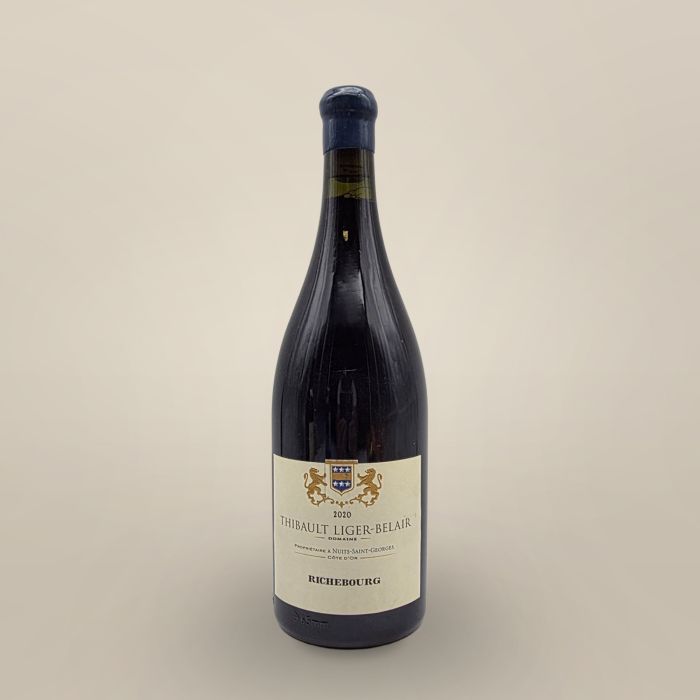
Domaine Thibault Liger Belair Richebourg 2020 Magnum (150cl)
Domaine Thibault Liger Belair Richebourg 2020 is a Burgundy red wine from the Richebourg Grand Cru in Vosne-Romanée. Crafted exclusively from Pinot Noir, it comes from a 0.52-hectare parcel planted between 1931 and 1936, located in the historic part of the cru at the southern end of the appellation. The estate practices manual harvesting with a proportion of whole clusters, followed by gentle fermentation and aging in oak barrels.
La bouteille proposée
- Size
- Magnum (150cl)
- Packaging
- Loose
- Label Condition
- Perfect
- Fill Level
- Perfect
- Capsule Condition
- Perfect
Identité du vin
- Couleur
- Red
- Pays
- France
- Région
- Bourgogne
- Appellation
- Vosne Romanée
- Producteur / Domaine
- Domaine Thibault Liger Belair
- Parcelle / Cru
- Richebourg
- Millésime
- 2020
Cépage et assemblage
- Grape Variety
- 100% Pinot Noir
Domaine Thibault Liger Belair
Domaine Thibault Liger-Belair is a family-run estate based in Nuits-Saint-Georges, in the Côte de Nuits. Founded in 2001 by Thibault Liger-Belair when he took over the family vineyards, which had previously been leased out on a sharecropping basis, the estate cultivates 7.25 hectares spread across Vosne-Romanée, Vougeot, Nuits-Saint-Georges, Gevrey-Chambertin and the regional appellations of Burgundy.
- Owner
- Thibault Liger-Belair
- Maître de chais
- Thibault Liger-Belair
- Surface (ha)
- 7.25 ha
- Production (average bottles per vintage)
- 60 000 bouteilles/an
Histoire du domaine
The estate’s vineyards have been linked to the Liger-Belair family since the 18th century. In 1720, Claude Marey, a vineyard owner and mayor of Nuits-Saint-Georges, founded the C. Marey company in Nuits to market his harvests. His son, Claude-Philibert Marey, succeeded him in 1781, and Guillaume-Félix Marey took over the management of the firm in 1804. In 1852, Guillaume-Félix Marey brought in his son-in-law, Count Louis Liger-Belair, owner of grands crus in Vosne-Romanée, as a partner, and the company took the name C. Marey and Count Liger-Belair. Following the death of Guillaume-Félix Marey in 1869, Count Liger-Belair took charge of the firm. On his death in 1878, his son Edgar Liger-Belair became sole head of the company and, in 1906, together with his three sons, founded the company Liger-Belair et Fils Successeurs. In 1949, Félix Liger-Belair chaired the board of directors, whilst his son Xavier served as managing director. Following Xavier’s death in 1982 and the sale of the wine-trading business, Vincent Liger-Belair took over the family estates and reorganised the sharecropping arrangements. In 2001, his son Thibault took over the management of the family vineyards, which had previously been farmed under sharecropping arrangements, and established the Domaine Thibault Liger-Belair. He subsequently also developed the Domaine des Pierres Roses in Moulin-à-Vent, the first plots of which were acquired in 2008, with the first vintage produced in 2009.
Richebourg
Richebourg is both a Grand Cru appellation and a physically delimited climat of Vosne-Romanée, consisting of the lieux-dits Les Richebourgs and Les Véroilles ou Richebourgs. It occupies the foothills of the slope between 260 and 290 meters, on a gentle slope facing east. Its shallow, clayey, carbonate-rich soils with high iron oxide content rest on Bajocian marls and soft limestones, beneath a colluvial cover blending scree, clays, and silts.
- Vineyard commune
- Vosne-Romanée
- Exposure
- facing east
- Altitude
- 260–290 m
- Slope
- gentle to slight slope
- Soil
- Sparsely developed, carbonate-rich, shallow and heavily clayey soils, rich in iron oxides; colluvium of scree, clays, and silts.
- Subsoil and geology
- Bajocian calcareous marls and soft, frost-susceptible limestones, resting on the Jurassic limestone series of the Côte de Nuits.
Le domaine dans cette parcelle
- Estate holding in the vineyard (ha)
- 0.520000 ha
- Vineyard holding status
- Owner; plot taken back after a period of sharecropping
- Indicative vine age
- Vines planted between 1931 and 1936.
Histoire de la parcelle
The name Richebourg is attested as early as 1512. The Abbey of Cîteaux owned vines on the site, probably since the 17th century, and contributed to its renown. Recognized among the finest crus in the classifications of the 18th and 19th centuries, Richebourg was extended in 1924 to include Les Véroilles sous Richebourg following an agreement between owners ratified by the Court of Appeal of Dijon. The appellation d'origine contrôlée was recognized on September 11, 1936, with the boundaries defined in 1924.


