




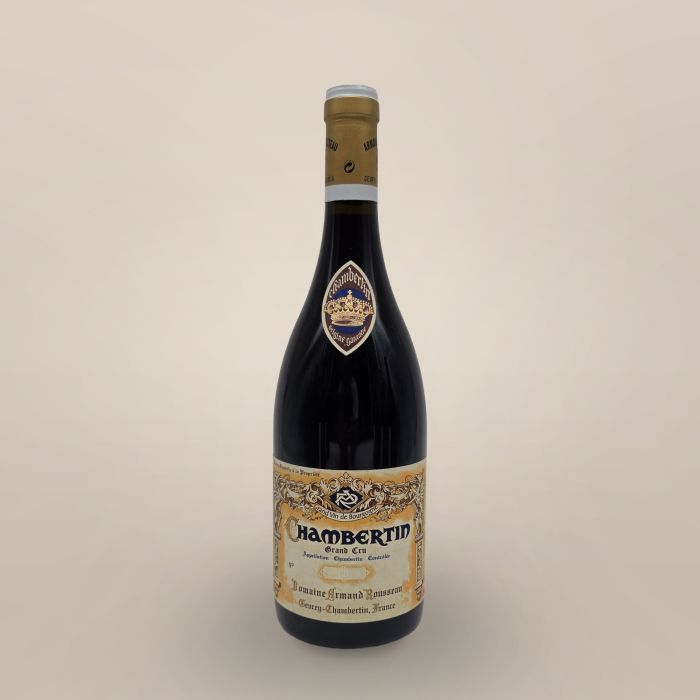
Domain Rousseau Chambertin Grand Cru 2006
The 2006 Domaine Rousseau Chambertin Grand Cru is a red Burgundy wine from the Chambertin parcel in the Gevrey-Chambertin appellation. Classified as a Burgundy Grand Cru, it is crafted by Domaine Rousseau—owned by Armand Rousseau—from 100% Pinot Noir. Jancis Robinson awards it 17.5/20 and indicates a drinking window from 2013 to 2018. Critics describe a wine with a pale ruby color, a charming and exotic floral profile of violet, accompanied by a slightly perceptible oak influence.
La bouteille proposée
- Size
- Bottle (75cl)
- Packaging
- Loose
- Label Condition
- Perfect
- Fill Level
- Perfect
- Capsule Condition
- Perfect
Identité du vin
- Couleur
- Red
- Pays
- France
- Région
- Bourgogne
- Appellation
- Gevrey Chambertin
- Producteur / Domaine
- Domaine Rousseau
- Parcelle / Cru
- Chambertin
- Millésime
- 2006
Cépage et assemblage
- Grape Variety
- 100% Pinot Noir
Domaine Rousseau
Domaine Armand Rousseau is a family-run estate based in Gevrey-Chambertin, in the Côte de Nuits. Éric Rousseau runs it with his daughter Cyrielle, the fourth generation of the family. The vineyard covers 15.33 hectares in Gevrey-Chambertin and Morey-Saint-Denis, spread across village, premier cru and grand cru appellations.
- Owner
- Éric Rousseau et Cyrielle Rousseau
- Maître de chais
- Éric Rousseau
- Surface (ha)
- 15.33 ha
- Production (average bottles per vintage)
- 63 000 bouteilles/an
Histoire du domaine
Armand Rousseau acquired his first vineyard plots in Gevrey-Chambertin in 1902, upon coming of age. Born into a family with links to viticulture, cooperage and wine trading, he gradually built up the estate in the early 20th century. Following his marriage in 1909, he expanded his wine-growing holdings. In particular, the estate acquired vineyards in Chambertin, Charmes-Chambertin and Clos de la Roche. Armand Rousseau also developed the estate’s own bottling operations during the interwar period. In 1954, the Clos Saint-Jacques Premier Cru was acquired in the name of his son Charles. Following Armand Rousseau’s accidental death in 1959, Charles took over the estate, which at that time comprised six hectares, and continued to develop it. Éric Rousseau joined his father in 1982 after studying oenology, and subsequently took over the running of the estate. Today, he manages it alongside his daughter Cyrielle, who represents the fourth generation of the family.
Chambertin
Chambertin is both a physically demarcated climat in Gevrey-Chambertin and the eponymous terroir of a Grand Cru appellation reserved for red wines. It occupies the middle of the slope, with an easterly exposure and a relatively moderate gradient compared to the neighboring Clos de Bèze. Its shallow, stony calcareous brown soils overlie entroquitic limestones and Bajocian marls, with a Bathonian component in the upper part.
- Vineyard commune
- Gevrey-Chambertin
- Origin of the vineyard name
- The toponym means "Bertin's field", named after a former owner or operator of the site; older forms such as "Champ Bretin" and "Champt Berthin" are attested in 1584.
- Exposure
- East, facing the rising sun
- Slope
- Mid-slope, relatively moderate gradient
- Soil
- Calcareous brown, stony soils beneath a thin cover of silts and scree.
- Subsoil and geology
- Entroquitic limestones and Bajocian marls; Bathonian calcareous clays towards the top.
Le domaine dans cette parcelle
- Estate holding in the vineyard (ha)
- 2.550000 ha
- Vineyard holding status
- Owner
- Indicative vine age
- Average age indicated as 60 years for the Chambertin vines (professional source published in 2018).
Histoire de la parcelle
The name Chambertin has been known since the 13th century, and its winegrowing potential has been recognized for centuries. Thomas Jefferson cited it among his favorite wines in 1787, while Napoleon I's predilection for this wine contributed to its renown. In 1855, Jules Lavalle classified it as "Tête de cuvée, cru hors ligne, vin extra". On October 17, 1847, its name was joined to that of Gevrey to form Gevrey-Chambertin; the Chambertin appellation was officially recognized on July 31, 1937.


