




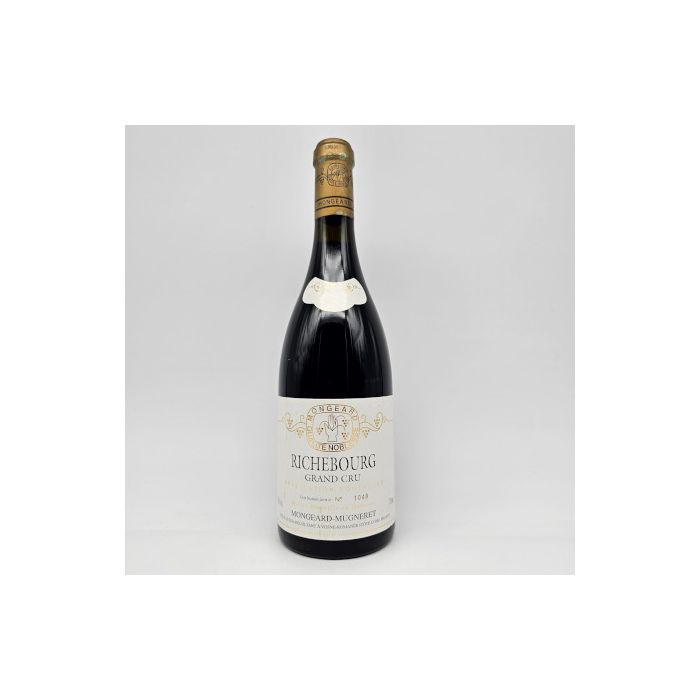
Domaine Mongeard Mugneret Richebourg 2013 Bouteille (75cl) ELA
The 2013 Domaine Mongeard-Mugneret Richebourg is a red Burgundy wine from the Richebourg climat, a Grand Cru in Vosne-Romanée. This cuvée is made from 100% Pinot Noir. The estate farms a small plot of vines here aged 40 to 60 years, harvested and sorted by hand. Aging is carried out in new oak barrels, respecting the distinct character of this Côte de Nuits Grand Cru.
La bouteille proposée
- Size
- Bottle (75cl)
- Packaging
- Loose
- Label Condition
- Slightly Damaged
- Fill Level
- Perfect
- Capsule Condition
- Perfect
Identité du vin
- Couleur
- Red
- Pays
- France
- Région
- Bourgogne
- Appellation
- Vosne Romanée
- Producteur / Domaine
- Domaine Mongeard Mugneret
- Parcelle / Cru
- Richebourg
- Millésime
- 2013
Cépage et assemblage
- Grape Variety
- 100% Pinot Noir
Domaine Mongeard Mugneret
Domaine Mongeard-Mugneret is a family-run estate based in Vosne-Romanée, in the Côte de Nuits. It cultivates 30 hectares spread across 37 Burgundy appellations, in both the Côte de Nuits and the Côte de Beaune. Its vineyards include, in particular, plots in Richebourg, Grands-Échezeaux, Échezeaux and Clos de Vougeot.
- Owner
- Famille Mongeard
- Maître de chais
- Vincent Mongeard
- Surface (ha)
- 30.00 ha
- Production (average bottles per vintage)
- 150 000 bouteilles/an
Histoire du domaine
The estate traces the origins of the Mongeard family back to Vosne-Romanée in 1620, whilst the family documents it cites allow us to trace the family’s history with certainty as far back as 1680. In 1920, the marriage of Eugène Mongeard and Edmée Mugneret brought together two families of winegrowers and laid the foundations for the estate’s current identity. Their son, Jean Mongeard, continued to develop the estate and its vineyards. In the 1970s, Vincent Mongeard joined his father at the estate and gradually took over the management of the vineyard. Jean Mongeard retired in 1995, leaving Vincent Mongeard in charge of the estate. Vincent Mongeard personally oversees the cuvées during winemaking, and the wine is matured in oak barrels. His grandson, Maxence, has recently joined the family estate. The estate now comprises 30 hectares of vineyards across 37 Burgundian appellations.
Richebourg
Richebourg is both a Grand Cru appellation and a physically delimited climat of Vosne-Romanée, consisting of the lieux-dits Les Richebourgs and Les Véroilles ou Richebourgs. It occupies the foothills of the slope between 260 and 290 meters, on a gentle slope facing east. Its shallow, clayey, carbonate-rich soils with high iron oxide content rest on Bajocian marls and soft limestones, beneath a colluvial cover blending scree, clays, and silts.
- Vineyard commune
- Vosne-Romanée
- Exposure
- facing east
- Altitude
- 260–290 m
- Slope
- gentle to slight slope
- Soil
- Sparsely developed, carbonate-rich, shallow and heavily clayey soils, rich in iron oxides; colluvium of scree, clays, and silts.
- Subsoil and geology
- Bajocian calcareous marls and soft, frost-susceptible limestones, resting on the Jurassic limestone series of the Côte de Nuits.
Le domaine dans cette parcelle
- Estate holding in the vineyard (ha)
- 0.310000 ha
- Indicative vine age
- Vines with an average age of 40 to 60 years according to the estate's Richebourg technical sheet.
Histoire de la parcelle
The name Richebourg is attested as early as 1512. The Abbey of Cîteaux owned vines on the site, probably since the 17th century, and contributed to its renown. Recognized among the finest crus in the classifications of the 18th and 19th centuries, Richebourg was extended in 1924 to include Les Véroilles sous Richebourg following an agreement between owners ratified by the Court of Appeal of Dijon. The appellation d'origine contrôlée was recognized on September 11, 1936, with the boundaries defined in 1924.


