




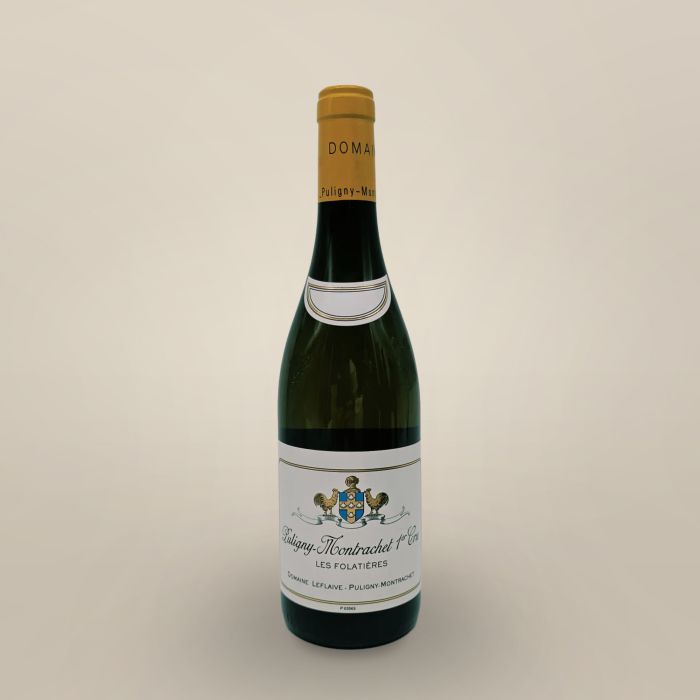
Domain Leflaive Folatieres 2018
Domaine Leflaive's Les Folatières 2018 is a white wine from Puligny-Montrachet, classified as a premier cru of Burgundy. Made from 100% Chardonnay, it comes from the Les Folatières parcel. Jancis Robinson awards it 17/20 and recommends drinking between 2023 and 2030. The critic describes a taut and fresh wine driven by citrus fruit, with a smoky expression, a creamier finish, and great length.
La bouteille proposée
- Size
- Bottle (75cl)
- Packaging
- Loose
- Label Condition
- Perfect
- Fill Level
- Perfect
- Capsule Condition
- Perfect
Identité du vin
- Couleur
- White
- Pays
- France
- Région
- Bourgogne
- Appellation
- Puligny Montrachet
- Producteur / Domaine
- Domaine Leflaive
- Parcelle / Cru
- Les Folatières
- Millésime
- 2018
Cépage et assemblage
- Grape Variety
- 100% Chardonnay
Domaine Leflaive
Domaine Leflaive is a family-run estate based in Puligny-Montrachet, in the heart of the Côte de Beaune. It cultivates 24 hectares of Chardonnay, spread across the appellations of Puligny-Montrachet, Meursault, Chassagne-Montrachet and several grands crus. The estate is run by Brice de La Morandière, representing the fourth generation linked to the Leflaive family.
- Owner
- Famille Leflaive
- Maître de chais
- Amandine Brillanceau
- Surface (ha)
- 24.00 ha
- Production (average bottles per vintage)
- 120 000 bouteilles/an
Histoire du domaine
The Leflaive family has been based in Puligny-Montrachet since 1717 and at that time owned a few vineyards, the grapes from which were sold. The estate in its modern form was established by Joseph Leflaive (1870–1953), an engineer by training, who returned to manage the family estate following the phylloxera crisis. From 1920 onwards, he embarked on a programme of replanting, acquiring and developing the vineyards, with the support of his estate manager, François Virot. He gradually began marketing the wines under his own label, whilst the first bottles were exported to the United States between 1932 and 1939. Following his death in 1953, his children Jo, Jeanne, Anne and Vincent kept the estate together and established a civil partnership in 1973. Jo took charge of administration and finances, whilst Vincent oversaw the vineyard, the wines and their marketing. Olivier Leflaive became co-manager alongside Vincent in 1986, then Anne-Claude Leflaive joined the management team in 1990 before being appointed manager in 1994. Under her leadership, the estate gradually adopted biodynamic farming during the 1990s. Following her death in April 2015, her nephew Brice de La Morandière, the great-grandson of Joseph Leflaive, became managing partner. Since January 2025, Amandine Brillanceau has held the post of technical director; Louis Brière is cellar master at Puligny-Montrachet.
Les Folatières
Les Folatières is a climat officially classified as a Premier Cru of the Puligny-Montrachet appellation, in the commune of the same name. Its regulatory perimeter brings together the lieux-dits Es Folatières, En la Richarde dit Les Folatières, Peux Bois dit Les Folatières, and Au Chaniot dit Les Folatières. It occupies a central position on the mid-slope and features limestone, stony soils, notably mixing ochre earth and stones. The orientations and altitudes published often concern the entire appellation or specific plots of producers and are therefore not retained here as exact values for the entire climat.
- Vineyard commune
- Puligny-Montrachet
- Origin of the vineyard name
- According to a tradition reported by several domains, the name derives from the Old French "Foletière", a place haunted by goblins or will-o'-the-wisps, with a connection to the Latin "follis", meaning bellows.
- Soil
- Limestone and stony soils, described as a mixture of ochre earth and stones; clay-limestone character reported by several operators.
Le domaine dans cette parcelle
- Estate holding in the vineyard (ha)
- 1.060000 ha
- Indicative vine age
- Plots planted in 1962 and 1999 according to the estate's current datasheet.
Histoire de la parcelle
Les Folatières appeared under the form "Es Follatières" among the climats of Puligny studied by Jules Lavalle in 1855, who placed it in the second cuvée. The climat is today registered in the specifications of Puligny-Montrachet among the denominations that can accompany the Premier Cru mention; the specific plot area of the premiers crus was approved by the INAO on May 17 and 18, 1984.


