




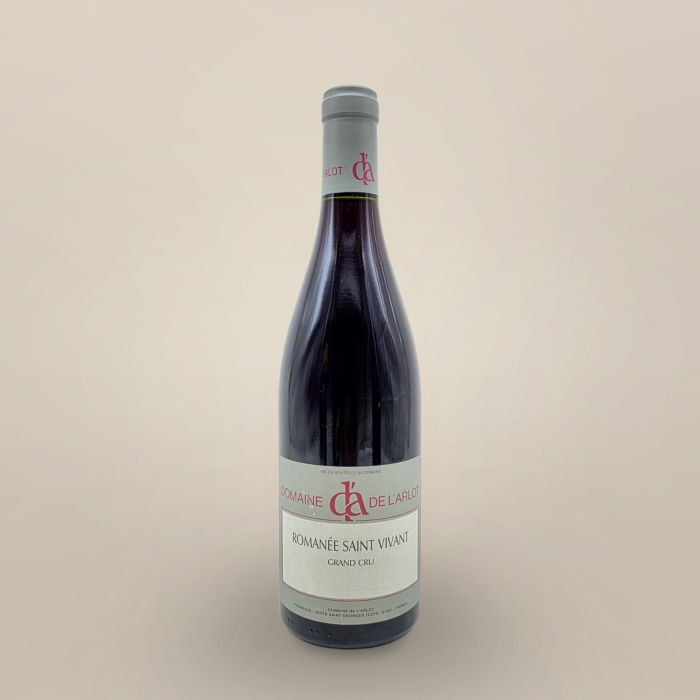
Domain de l'Arlot Romanee Saint Vivant 2015 Double-Magnum
The 2015 Domaine de l’Arlot Romanée-Saint-Vivant is a Pinot Noir red wine from the Romanée-Saint-Vivant grand cru in Vosne-Romanée, Burgundy. The Wine Advocate awards it 95-97/100 and recommends a drinking window of 2022 to 2050; James Suckling rates it 98/100, from 2022. Critics describe a precise and aromatic wine with red fruit and dark berries, supported by vibrant acidity, ripe and velvety tannins, and a long, spicy, chalky finish.
La bouteille proposée
- Size
- Jeroboam (300cl)
- Packaging
- Loose
- Label Condition
- Perfect
- Fill Level
- Perfect
- Capsule Condition
- Perfect
Identité du vin
- Couleur
- Red
- Pays
- France
- Région
- Bourgogne
- Appellation
- Vosne Romanée
- Producteur / Domaine
- Domaine de l'Arlot
- Parcelle / Cru
- Romanée-Saint-Vivant
- Millésime
- 2015
Cépage et assemblage
- Grape Variety
- 100% Pinot Noir
Domaine de l'Arlot
Domaine de l’Arlot is a vineyard in the Côte de Nuits region, situated in Prémeaux-Prissey, 2 km south of Nuits-Saint-Georges. Owned by AXA Millésimes since 1987, it cultivates 14.9 hectares, mainly in Nuits-Saint-Georges and Vosne-Romanée. Its vineyards include, in particular, the monopoles of Clos de l’Arlot and Clos des Forêts Saint-Georges.
- Owner
- AXA Millésimes
- Maître de chais
- Géraldine Godot
- Surface (ha)
- 15.00 ha
- Production (average bottles per vintage)
- environ 60 000 bouteilles/an
Histoire du domaine
The estate’s origins date back to the late 18th century, when Jean-Charles Vienot owned a house and vineyards in Prémeaux. He had the estate walled in and created the Clos de l’Arlot, now classified as a Nuits-Saint-Georges Premier Cru. In 1891, the estate was acquired by the wine merchant Jules Belin. He expanded it to include the Clos des Forêts Saint-Georges and the Clos du Chapeau, forming the entire Domaine de l’Arlot. Jules Belin’s heirs sold the buildings and vineyards to AXA Millésimes in early 1987. AXA Millésimes subsequently expanded the vineyard with plots in Vosne-Romanée, in the Les Suchots and Romanée-Saint-Vivant climats. Jean-Pierre de Smet managed the estate for nearly two decades before handing over the reins to Christian Seely in January 2007. Following in the footsteps of Olivier Leriche and then Jacques Devauges, Géraldine Godot has been in charge of the estate’s technical management since September 2014.
Romanée-Saint-Vivant
Romanée-Saint-Vivant is a physically demarcated climat of Vosne-Romanée corresponding to a Grand Cru appellation reserved for red wines. Located on a gentle piedmont plateau overlooking the village, between 247 and 260 meters, it slopes gently eastward. Its shallow, clayey, carbonate-rich soils with high iron oxide content cover a well-draining limestone subsoil, with a conglomeratic formation in its eastern part.
- Vineyard commune
- Vosne-Romanée
- Origin of the vineyard name
- The name "Romanée de Saint-Vivant" is recorded in 1765. "Romanée" was borrowed from a small neighboring parcel, while "Saint-Vivant" recalls the Cluniac monastery that historically owned the vineyard.
- Exposure
- eastward
- Altitude
- 247–260 m
- Slope
- gentle slope on a slight plateau
- Soil
- Slightly developed, carbonated, and shallow soils, heavily clayey, rich in iron oxides; colluvium of scree, clays, and silts.
- Subsoil and geology
- Bajocian entroquitic limestones; to the east, a conglomerate of limestone blocks in a salmon-pink marly matrix.
Le domaine dans cette parcelle
- Estate holding in the vineyard (ha)
- 0.250000 ha
- Year the vineyard was acquired
- 1991
- Vineyard holding status
- estate owner-grower
- Indicative vine age
- Vines stated to be 33 years old in 2004, indicating planting around 1971.
Histoire de la parcelle
The Cluniac monastery of Saint-Vivant owned a wine estate in Vosne as early as the Middle Ages, consisting of clos precisely listed in 1512. The current climat brings together the former Cloux des Neuf Journaux, des Quatre Journaux, and du Moytant. Confiscated as ecclesiastical property during the French Revolution, it was acquired by the Marey-Monge family, who kept it until 1898 before it was partially divided. Already placed in the top categories of the 1816, 1855, and 1860 classifications, Romanée-Saint-Vivant was recognized as an appellation d'origine contrôlée on September 11, 1936.


