




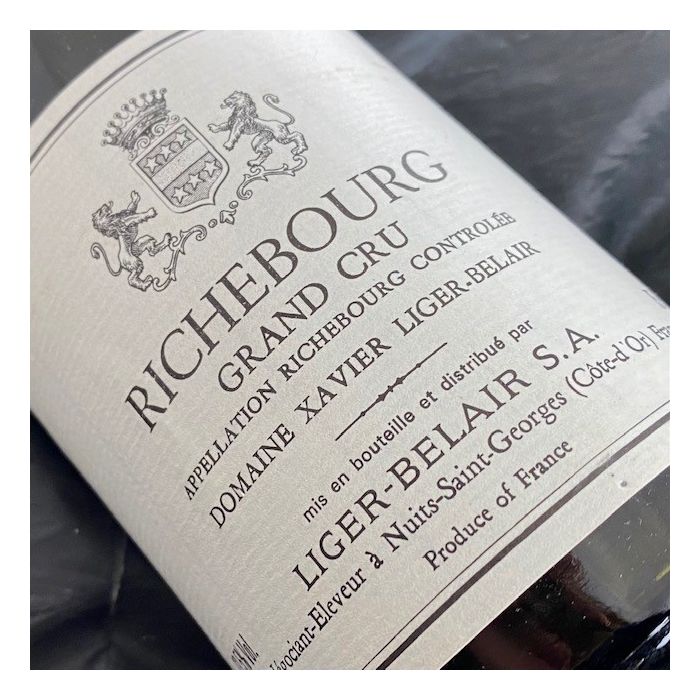
Domaine Comte Liger Belair Richebourg 1949 Magnum (150cl)
The 1949 Domaine Comte Liger Belair Richebourg is a red Burgundy wine from the Richebourg climat, a grand cru located in Vosne-Romanée, crafted by the Domaine du Vicomte Liger Belair. It is made from 100% Pinot Noir. The Richebourg appellation is produced within the commune of Vosne-Romanée. The Liger-Belair family has been established in this village since 1815, anchoring this old bottle in a long local winemaking history.
La bouteille proposée
- Size
- Magnum (150cl)
- Packaging
- Loose
- Label Condition
- Perfect
- Fill Level
- Perfect
- Capsule Condition
- Perfect
Identité du vin
- Couleur
- Red
- Pays
- France
- Région
- Bourgogne
- Appellation
- Vosne Romanée
- Producteur / Domaine
- Domaine du Vicomte Liger Belair
- Parcelle / Cru
- Richebourg
- Millésime
- 1949
Cépage et assemblage
- Grape Variety
- 100% Pinot Noir
Domaine du Vicomte Liger Belair
The Domaine du Comte Liger-Belair is a family-run estate in Vosne-Romanée, in the Côte de Nuits, managed by Count Louis-Michel Liger-Belair. Established in its current form in 2000, it is part of the Liger-Belair family’s history in Vosne, which dates back to 1815. The estate cultivates 10.5 hectares in Vosne-Romanée, Nuits-Saint-Georges and Flagey-Échezeaux, including the La Romanée Grand Cru monopoly.
- Owner
- Famille Liger-Belair (domaine dirigé par le comte Louis-Michel Liger-Belair)
- Maître de chais
- Louis-Michel Liger-Belair
- Surface (ha)
- 10.50 ha
Histoire du domaine
The family’s history in Vosne dates back to 1815, when the Napoleonic general Louis Liger-Belair acquired the Château de Vosne. The estate subsequently expanded under his management and then under that of his adopted son, Count Louis-Charles Liger-Belair, who married Ludovie Marey, a descendant of a Burgundian family of winegrowers and merchants established since 1720. On the death of Count Edgar, son of Louis-Charles, the family estate covered more than 60 hectares, mainly in the Côte de Nuits. In 1924, Count Henri Liger-Belair bequeathed the Château de Vosne-Romanée and 24 hectares of vineyards to his widow and their ten children. The current estate was established in early 2000 by his great-grandson, Louis-Michel Liger-Belair, an agricultural engineer and oenologist. He then took over the management of 1.5 hectares of family-owned vineyards, followed by a further 1.6 hectares in 2002, including La Romanée and Aux Reignots. In 2006, the estate leased 5.5 hectares from the former Lamadon family of sharecroppers. Vineyard management was converted to biodynamic methods in 2008 and has been certified under the Biodyvin label since 2012. In the same year, the estate acquired the Clos des Grandes Vignes, a monopole Premier Cru vineyard in Nuits-Saint-Georges. Louis-Michel Liger-Belair oversees the running of the estate and the winemaking process, from the vineyard to bottling.
Richebourg
Richebourg is both a Grand Cru appellation and a physically delimited climat of Vosne-Romanée, consisting of the lieux-dits Les Richebourgs and Les Véroilles ou Richebourgs. It occupies the foothills of the slope between 260 and 290 meters, on a gentle slope facing east. Its shallow, clayey, carbonate-rich soils with high iron oxide content rest on Bajocian marls and soft limestones, beneath a colluvial cover blending scree, clays, and silts.
- Vineyard commune
- Vosne-Romanée
- Exposure
- facing east
- Altitude
- 260–290 m
- Slope
- gentle to slight slope
- Soil
- Sparsely developed, carbonate-rich, shallow and heavily clayey soils, rich in iron oxides; colluvium of scree, clays, and silts.
- Subsoil and geology
- Bajocian calcareous marls and soft, frost-susceptible limestones, resting on the Jurassic limestone series of the Côte de Nuits.
Histoire de la parcelle
The name Richebourg is attested as early as 1512. The Abbey of Cîteaux owned vines on the site, probably since the 17th century, and contributed to its renown. Recognized among the finest crus in the classifications of the 18th and 19th centuries, Richebourg was extended in 1924 to include Les Véroilles sous Richebourg following an agreement between owners ratified by the Court of Appeal of Dijon. The appellation d'origine contrôlée was recognized on September 11, 1936, with the boundaries defined in 1924.


