




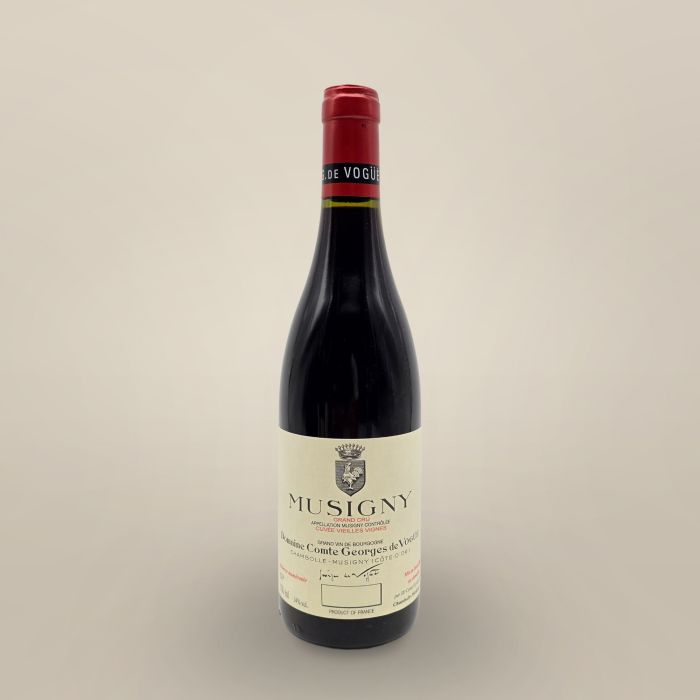
Domain Comte De Vogue Musigny Grand Cru 1976 Bottle (75cl) HD
Domaine Comte de Vogüé Musigny Grand Cru 1976 is a red Burgundy wine from the Musigny climat in the commune of Chambolle-Musigny, in the heart of the Côte de Nuits. Produced by Domaine Comte de Vogüé, it is crafted exclusively from Pinot Noir. This Vieilles Vignes cuvée comes from the Musigny parcel and holds the Burgundy Grand Cru classification. Musigny is located between the premier cru Les Amoureuses and the grand cru Échezeaux.
La bouteille proposée
- Size
- Bottle (75cl)
- Packaging
- Loose
- Label Condition
- Highly Damaged
- Fill Level
- Perfect
- Capsule Condition
- Perfect
Identité du vin
- Couleur
- Red
- Pays
- France
- Région
- Bourgogne
- Appellation
- Chambolle Musigny
- Producteur / Domaine
- Domaine Comte de Vogue
- Parcelle / Cru
- Musigny [Rouge]
- Millésime
- 1976
Cépage et assemblage
- Grape Variety
- 100% Pinot Noir
Domaine Comte de Vogue
Domaine Comte Georges de Vogüé is a family-run estate based in Chambolle-Musigny, in the Côte de Nuits. Its origins date back to the 15th century and it is now owned by Claire de Causans and Marie de Ladoucette, descendants of Count Georges de Vogüé. The vineyard covers 12.43 hectares in Chambolle-Musigny, including 7.12 hectares in the Musigny Grand Cru, to which the estate has historic ties.
- Owner
- Comtesse Claire de Causans et Marie de Ladoucette
- Maître de chais
- Jean Lupatelli
- Surface (ha)
- 12.43 ha
- Production (average bottles per vintage)
- environ 40 000 à 45 000 bouteilles/an
Histoire du domaine
The origins of Domaine Comte Georges de Vogüé date back to 1450, when the estate’s historic building was established in Chambolle-Musigny. The property has remained in the same family throughout the centuries, including during the French Revolution. The name Vogüé became associated with the estate in 1766, following the marriage of Catherine Bouhier de Versalieu to Cerice François Melchior de Vogüé. In 1925, Count Georges de Vogüé inherited the vineyards from his father, Count Arthur de Vogüé, and gave the estate his name. He managed the estate for over fifty years. His granddaughters, Claire de Causans and Marie de Ladoucette, inherited the vineyards from their mother in 2002 and are the current owners. François Millet was responsible for winemaking from 1986 to 2021. Jean Lupatelli succeeded him in spring 2021 as winemaker and cellar master; his responsibilities were subsequently expanded to include the estate’s operational and commercial management. The estate’s vineyard comprises, in particular, 7.12 hectares in Musigny and 2.66 hectares in Bonnes-Mares.
Musigny [Rouge]
Musigny is a Grand Cru appellation and a physically demarcated terroir in Chambolle-Musigny, in the heart of the Côte de Nuits. Located above Clos de Vougeot, between the Premier Cru Les Amoureuses and the Grand Cru Échezeaux, it includes the lieux-dits Les Musigny, Les Petits Musigny, and part of La Combe d’Orveau. The vineyard occupies a fairly steep limestone and rocky terrace, the southern part of which rises towards the Combe d’Orveau. The appellation permits red wines and, as a singularity in the Côte de Nuits, a small production of white wine.
- Vineyard commune
- Chambolle-Musigny
- Origin of the vineyard name
- The BIVB links the name to a Musigny family active at the court of the Dukes of Burgundy in the 14th century; an INAO source also mentions a Gallo-Roman estate belonging to someone named Musinus.
- Exposure
- East to southeast
- Altitude
- 260–300 m
- Slope
- 8 to 14%
- Soil
- Shallow soils, with a little red clay in the upper part; overall more clayey and less calcareous than neighboring Grands Crus.
- Subsoil and geology
- Jurassic limestone and rocky terrace, formed approximately 150 million years ago.
Le domaine dans cette parcelle
- Vineyard holding status
- owner
Histoire de la parcelle
The reputation and demarcation of Musigny predate the AOC system: a judgment defining the cru dates from April 16, 1929. The Musigny Appellation d'Origine Contrôlée was initially recognized by the decree of September 11, 1936. The currently demarcated parcel area mentioned in the product specification was approved by the INAO during the sessions of June 1 and 2, 1988.


