




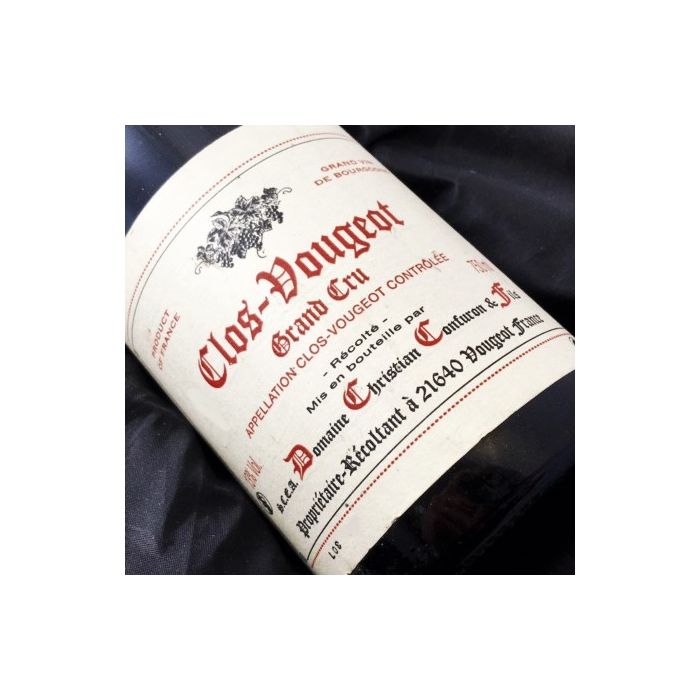
Domaine Christian Confuron Clos Vougeot 1995 Bottle (75cl)
Domaine Christian Confuron Clos Vougeot 1995 is a Burgundy red wine from the Clos de Vougeot Grand Cru, in the commune of Vougeot. Crafted exclusively from Pinot Noir, it comes from a 25.68-are plot farmed by the estate within this famous Burgundian clos. Clos de Vougeot, shared among more than 70 owners, covers approximately 50 hectares of Grand Cru. This 1995 vintage expresses the identity of a Pinot Noir cuvée hailing from an emblematic site in the Côte de Nuits.
La bouteille proposée
- Size
- Bottle (75cl)
- Packaging
- Loose
- Label Condition
- Perfect
- Fill Level
- Perfect
- Capsule Condition
- Perfect
Identité du vin
- Couleur
- Red
- Pays
- France
- Région
- Bourgogne
- Appellation
- Vougeot
- Producteur / Domaine
- Domaine Christian Confuron
- Parcelle / Cru
- Clos de Vougeot
- Millésime
- 1995
Cépage et assemblage
- Grape Variety
- 100% Pinot Noir
Domaine Christian Confuron
Christian Confuron et Fils was a 6-hectare estate historically based in Vougeot, in the Côte de Nuits. Its vineyards, spread across Chambolle-Musigny, Vougeot and Nuits-Saint-Georges, include plots in Bonnes-Mares and Clos de Vougeot. Acquired by Evenstad Estates in 2021, it is now operated under the name Domaine Evenstad, based in Santenay.
- Owner
- Evenstad Estates (famille Evenstad), via le Domaine Evenstad
- Surface (ha)
- 6.00 ha
Histoire du domaine
Domaine Christian Confuron et Fils was a family-run estate in the Côte de Nuits, based in Vougeot and passed down within the Confuron family. Philippe Confuron took over the running of the estate after Christian Confuron; professional sources referred to him as the estate manager prior to its sale. The vineyard covered 6 hectares, mainly planted with Pinot Noir, with a small plot of Pinot Blanc in Nuits-Saint-Georges. It comprised plots in village, premier cru and grand cru appellations, notably in Chambolle-Musigny, Nuits-Saint-Georges, Bonnes-Mares and Clos de Vougeot. In June 2021, Evenstad Estates took control of the estate. Philippe Confuron stepped down from his role as co-manager of the company with effect from 31 December 2021. The company subsequently adopted the name Domaine Evenstad in July 2022; it was renamed ‘DE’ in the registers in July 2023. Domaine Evenstad now owns this 6-hectare plot in the Côte de Nuits, whilst its winemaking facilities are located in Santenay. Wines labelled ‘Christian Confuron et Fils’ therefore reflect the estate’s former identity.
Clos de Vougeot
The Clos de Vougeot is a vast, single-piece vineyard enclosure, surrounded by walls and located at the foot of the Côte de Nuits slope, in the commune of Vougeot. Its terroir varies markedly from top to bottom: thin, gravelly soils on Bajocian limestone in the upper part, more clayey brown soils on limestone debris in the middle, and deeper, clayey and silty soils on a marly layer in the lower part. The site simultaneously constitutes a physically demarcated Burgundian climat and the emblematic parcel area of the AOC Grand Cru Clos de Vougeot or Clos Vougeot.
- Vineyard commune
- Vougeot
- Origin of the vineyard name
- "Clos" designates the vineyard historically enclosed by walls; "Vougeot" takes up the name of the place, linked to the Vouge which marks a historical boundary of the estate.
- Altitude
- 240–265 m
- Slope
- gentle, average of about 3.8%
- Soil
- At the top, shallow, granular soils rich in gravel; in the middle, shallow, more clayey brown soils on limestone debris; at the bottom, deeper brown soils rich in clay and fine silt.
- Subsoil and geology
- Jurassic complex; Bajocian limestone slab in the upper part, limestone debris in the middle, and marly layer in the lower part, with the influence of superficial formations linked to the outlet of the combe d'Orveau.
Le domaine dans cette parcelle
- Estate holding in the vineyard (ha)
- 0.257000 ha
- Indicative vine age
- 45 years old according to the estate's official technical sheet.
Histoire de la parcelle
The wine estate was gradually established by the Cistercian abbey of Cîteaux starting from the early 12th century; a medieval agreement set boundaries that have remained almost unchanged, and the wall was built before the end of that century. The farm buildings were developed from the 12th to the 15th century, then complemented in 1551 by the Renaissance residence that became the château du Clos de Vougeot. The abbey kept the estate until the Revolution; the buildings and vineyards were confiscated and then sold as national property in 1791, subsequently leading to the fragmentation of the property. The appellation d'origine contrôlée Clos de Vougeot or Clos Vougeot was recognized by decree on July 31, 1937.


