




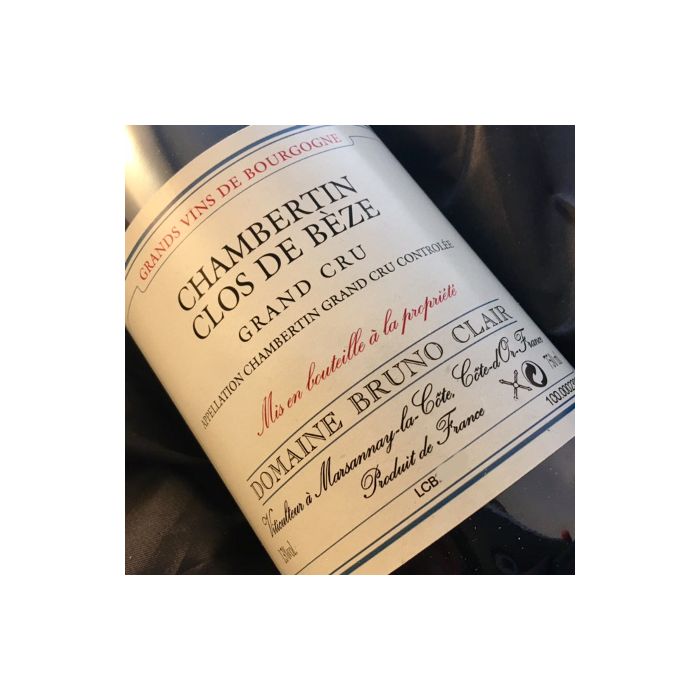
Domain Bruno Clair Chambertin Clos de Beze 2008
The 2008 Domaine Bruno Clair Chambertin-Clos-de-Bèze is a red Burgundy wine from the Chambertin-Clos-de-Bèze grand cru in the Gevrey-Chambertin appellation. Made from 100% Pinot Noir, it comes from the Chambertin-Clos-de-Bèze parcel. The Wine Advocate awards it 95/100 and recommends drinking between 2018 and 2038. The review highlights a fresh, floral profile, underpinned by dark red berries, mineral and menthol notes, with a silky texture and a generous finish.
La bouteille proposée
- Size
- Bottle (75cl)
- Packaging
- Original Wooden Case of 6
- Label Condition
- Perfect
- Fill Level
- Perfect
- Capsule Condition
- Perfect
Identité du vin
- Couleur
- Red
- Pays
- France
- Région
- Bourgogne
- Appellation
- Gevrey Chambertin
- Producteur / Domaine
- Domaine Bruno Clair
- Parcelle / Cru
- Chambertin-Clos-de-Bèze
- Millésime
- 2008
Cépage et assemblage
- Grape Variety
- 100% Pinot Noir
Domaine Bruno Clair
Domaine Bruno Clair is a family-run estate based in Marsannay-la-Côte, in the Côte de Nuits. Founded by Bruno Clair in 1979, it now cultivates 27 hectares spread across eight Burgundian villages and produces 32 appellations. Édouard and Arthur Clair work together to oversee the winemaking and cellar operations.
- Owner
- Famille Clair
- Maître de chais
- Édouard Clair et Arthur Clair
- Surface (ha)
- 27.00 ha
- Production (average bottles per vintage)
- 110 000 bouteilles/an
Histoire du domaine
Bruno Clair founded the estate that bears his name in 1979, in Marsannay-la-Côte. His family’s history in wine-making, however, dates back to the early 19th century. In 1919, his grandfather Joseph Clair married Marguerite Daü, who was then running a vineyard in Marsannay-la-Côte. Between 1930 and 1960, Joseph Clair acquired plots in Gevrey-Chambertin, Morey-Saint-Denis and Chambolle-Musigny. In 1954, he founded the Clair-Daü estate with his family; following his death in 1971, his son Bernard took over the management. The break-up of the Clair-Daü estate in 1985 led Bernard and Geneviève Clair to entrust their vineyards to Bruno, who then set up a family-run wine-growing business with his brothers and sisters. From 1986 onwards, Domaine Bruno Clair managed 17 hectares, before gradually expanding into Chambolle-Musigny, Aloxe-Corton, Pernand-Vergelesses, Gevrey-Chambertin, Bonnes-Mares and, once again, Chambolle-Musigny. Isabelle Clair joined the estate in 2005 to take on administrative and commercial responsibilities. Their son Édouard joined in 2010, followed by Margaux and Arthur in 2018; Édouard is in charge of the vineyards and winemaking, whilst Arthur is in charge of the cellar and assists with winemaking. The estate now cultivates 27 hectares across eight villages.
Chambertin-Clos-de-Bèze
Chambertin-Clos de Bèze is a physically delimited Grand Cru appellation whose parcel area corresponds exclusively to the "Clos de Bèze" lieu-dit in Gevrey-Chambertin. The terroir occupies an east-facing hillside, with piedmont plots at the heart of a small amphitheater. The shallow, well-draining, carbonated clay-limestone soils combine scree, clays, and red silts. They primarily overlie a Bajocian substratum of crinoidal limestone and marly levels.
- Vineyard commune
- Gevrey-Chambertin
- Origin of the vineyard name
- The name "Clos de Bèze" recalls the former wine estate of the Abbaye de Bèze, which owned the site as early as the 7th century; the term "clos" has survived despite the disappearance of its walls.
- Exposure
- Levant, generally east-facing
- Slope
- Piedmont, at the heart of a small amphitheater
- Soil
- Shallow, carbonated, and well-draining clay-limestone soils, with scree, clays, and red silts.
- Subsoil and geology
- Plateau of hard Bajocian crinoidal limestone, with marly levels; Bathonian towards the upper part.
Le domaine dans cette parcelle
- Estate holding in the vineyard (ha)
- 0.980000 ha
- Year the vineyard was acquired
- 1986
- Indicative vine age
- Plot planted in 1912, 1974, and 1987.
Histoire de la parcelle
Clos de Bèze has been known since the 7th century, and the BIVB dates its entry into history to 640 as a monastic property of the Abbaye de Bèze. It was transferred to the Chapter of Langres in the early 13th century, then remained in the hands of the canons until the French Revolution, when it was divided among multiple owners. The Chambertin-Clos de Bèze appellation d'origine contrôlée was recognized by the decree of July 31, 1937; its delimited parcel area corresponds exclusively to the lieu-dit Clos de Bèze.


