




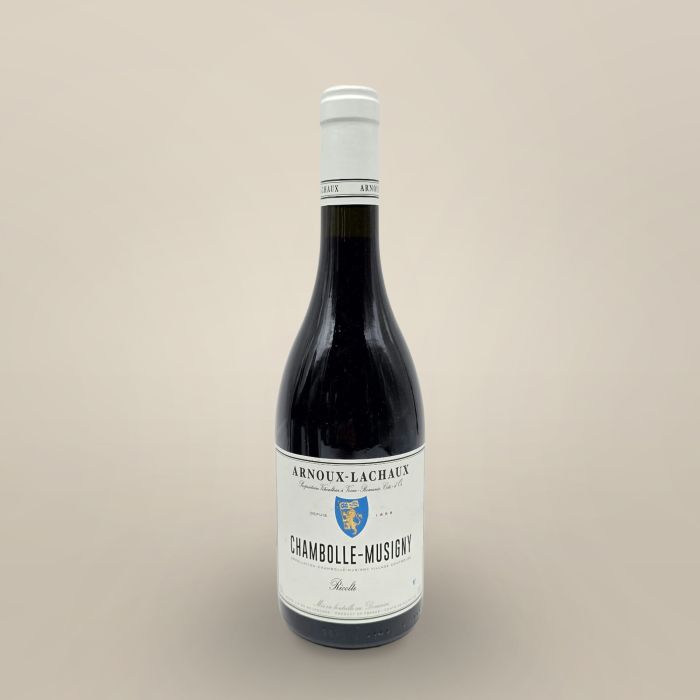
Domain Arnoux Lachaux Chambolle Musigny 2019 Bottle (75cl)
Domaine Arnoux-Lachaux Chambolle-Musigny 2019 is a Burgundy red wine from the Chambolle-Musigny appellation and classified as Premier Cru. Crafted exclusively from Pinot Noir, it is produced by Domaine Arnoux-Lachaux, a wine estate based in Vosne-Romanée. The estate farms 14 hectares and implements regenerative viticulture, including biodynamics, eco-pasturing, and practices aimed at preserving vine vigor.
La bouteille proposée
- Size
- Bottle (75cl)
- Packaging
- Original Box
- Label Condition
- Perfect
- Fill Level
- Perfect
- Capsule Condition
- Perfect
Identité du vin
- Couleur
- Red
- Pays
- France
- Région
- Bourgogne
- Appellation
- Chambolle Musigny
- Producteur / Domaine
- Domaine Arnoux Lachaux
- Millésime
- 2019
Cépage et assemblage
- Grape Variety
- 100% Pinot Noir
Domaine Arnoux Lachaux
Domaine Arnoux-Lachaux is a 14-hectare family-run estate based in Vosne-Romanée, in the Côte de Nuits. Founded in 1858, it is now run by Florence Arnoux-Lachaux, alongside her son Charles Lachaux, who is responsible for the vineyards and winemaking. The vineyard is managed using regenerative and biodynamic farming practices.
- Owner
- Florence Arnoux-Lachaux
- Maître de chais
- Charles Lachaux
- Surface (ha)
- 14.00 ha
- Production (average bottles per vintage)
- 40 000 bouteilles/an
Histoire du domaine
The estate was founded in Vosne-Romanée in 1858, following the union of the Arnoux and Salbreux winegrowing families. It subsequently took the name Domaine Robert Arnoux when Robert Arnoux took over the estate in 1957 following the death of his father, Charles Arnoux. Robert Arnoux developed the estate’s in-house bottling operations from the late 1950s and early 1960s onwards. Following his death in February 1995, his daughter Florence Arnoux and her husband Pascal Lachaux continued to run the estate. The estate took the name Domaine Arnoux-Lachaux from the 2007 vintage onwards. Charles Lachaux joined the family business in 2011 and has been in charge of winemaking since the 2012 vintage. Under his leadership, the estate has adopted practices including biodynamics, eco-grazing, goblet pruning, higher trellising and the cessation of leaf removal. Since 2012, winemaking has been carried out using whole bunches, with short vatting periods and minimal intervention. From the 2022 harvest onwards, the estate has replaced oak barrels with stoneware vessels for ageing.


