




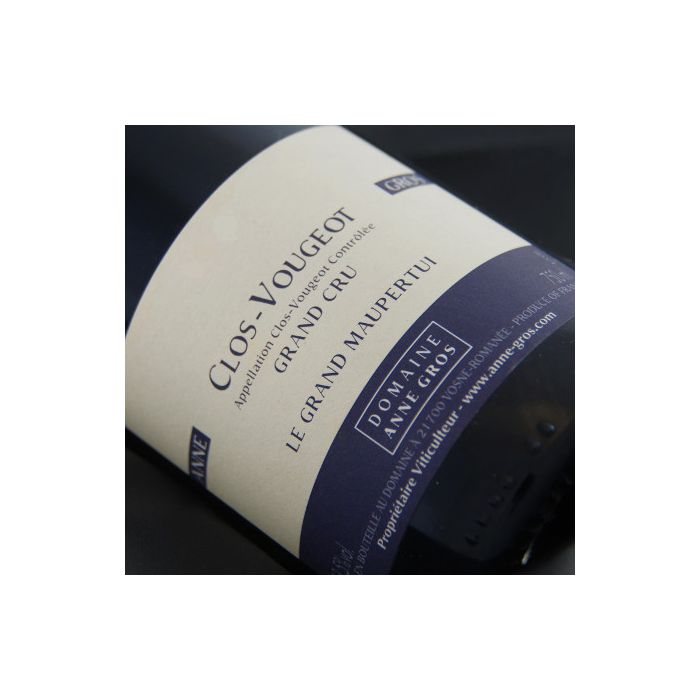
Domaine Anne Gros Clos Vougeot Grand Maupertui 2008
The 2008 Domaine Anne Gros Clos Vougeot Grand Maupertui is a red Burgundy wine, produced under the Vougeot Grand Cru appellation from Pinot Noir. Coming from the Clos de Vougeot parcel and the Grand Maupertui cuvée, it was awarded 92/100 by The Wine Advocate. The critic describes a profile combining ripe and tangy black raspberry, smoky notes, a mineral nuance, and a savory register, carried by refined tannins and a fine texture. The Wine Advocate also highlights the purity of the fruit and a savory finish.
La bouteille proposée
- Size
- Bottle (75cl)
- Packaging
- Loose
- Label Condition
- Perfect
- Fill Level
- Perfect
- Capsule Condition
- Perfect
Identité du vin
- Couleur
- Red
- Pays
- France
- Région
- Bourgogne
- Appellation
- Vougeot
- Producteur / Domaine
- Domaine Anne Gros
- Parcelle / Cru
- Clos de Vougeot
- Millésime
- 2008
Cépage et assemblage
- Grape Variety
- 100% Pinot Noir
Domaine Anne Gros
Domaine Anne Gros is a family-run estate in Vosne-Romanée, in the Côte de Nuits, run by the Gros family, who have been based in the village since the 19th century. Its vineyard, covering approximately 6.5 hectares, comprises plots in Bourgogne, Hautes-Côtes de Nuits, Chambolle-Musigny and Vosne-Romanée, as well as in the grands crus of Echezeaux, Clos de Vougeot and Richebourg. Passed on in 2019 to Anne Gros’s three children, the estate is now run by the family, with Julie Tollot-Gros and Paul Gros playing an increasingly active role in its day-to-day management and winemaking decisions.
- Owner
- Julie Tollot-Gros, Paul Gros et Marine Gros
- Maître de chais
- Anne Gros, avec Julie Tollot-Gros et Paul Gros
- Surface (ha)
- 6.50 ha
- Production (average bottles per vintage)
- environ 30 000 bouteilles/an
Histoire du domaine
The Gros family has been based in Vosne-Romanée since 1830, when Alphonse Gros settled there, according to the estate’s chronology. His son, Louis-Gustave Gros, expanded the sale of bottled wines to private customers from the 1880s onwards. Louis Gros then continued to develop the family estate until his death in 1951, after which the property was divided amongst his four children. François Gros, Anne’s father, initially managed his vineyards with his brother Jean, before devoting himself to his own estate from 1970 onwards, comprising around three hectares. He had a winery built in 1971 and, at the same time, ran a small wine trading business. From 1978 onwards, health problems led him to scale back his activities, and a large proportion of the production was sold in casks to Burgundian wine merchants. Anne Gros took over the family estate in 1988 under the name Anne and François Gros, whilst François continued to look after the vineyards. She then expanded the estate, notably through the acquisition of the Barreaux plot in Vosne-Romanée and by planting new vines in Burgundy and the Hautes-Côtes de Nuits. All the wines have been bottled at the estate since 1990, and the business adopted the name Domaine Anne Gros in 1995. In 2019, Anne Gros handed the estate over to her three children, Julie, Paul and Marine, whilst continuing to support the training of the two eldest. Julie Tollot-Gros and Paul Gros are gradually taking on a significant role in day-to-day operations and winemaking decisions.
Clos de Vougeot
The Clos de Vougeot is a vast, single-piece vineyard enclosure, surrounded by walls and located at the foot of the Côte de Nuits slope, in the commune of Vougeot. Its terroir varies markedly from top to bottom: thin, gravelly soils on Bajocian limestone in the upper part, more clayey brown soils on limestone debris in the middle, and deeper, clayey and silty soils on a marly layer in the lower part. The site simultaneously constitutes a physically demarcated Burgundian climat and the emblematic parcel area of the AOC Grand Cru Clos de Vougeot or Clos Vougeot.
- Vineyard commune
- Vougeot
- Origin of the vineyard name
- "Clos" designates the vineyard historically enclosed by walls; "Vougeot" takes up the name of the place, linked to the Vouge which marks a historical boundary of the estate.
- Altitude
- 240–265 m
- Slope
- gentle, average of about 3.8%
- Soil
- At the top, shallow, granular soils rich in gravel; in the middle, shallow, more clayey brown soils on limestone debris; at the bottom, deeper brown soils rich in clay and fine silt.
- Subsoil and geology
- Jurassic complex; Bajocian limestone slab in the upper part, limestone debris in the middle, and marly layer in the lower part, with the influence of superficial formations linked to the outlet of the combe d'Orveau.
Le domaine dans cette parcelle
- Vineyard holding status
- Owner of a plot in the lieu-dit Le Grand Maupertui
Histoire de la parcelle
The wine estate was gradually established by the Cistercian abbey of Cîteaux starting from the early 12th century; a medieval agreement set boundaries that have remained almost unchanged, and the wall was built before the end of that century. The farm buildings were developed from the 12th to the 15th century, then complemented in 1551 by the Renaissance residence that became the château du Clos de Vougeot. The abbey kept the estate until the Revolution; the buildings and vineyards were confiscated and then sold as national property in 1791, subsequently leading to the fragmentation of the property. The appellation d'origine contrôlée Clos de Vougeot or Clos Vougeot was recognized by decree on July 31, 1937.


