



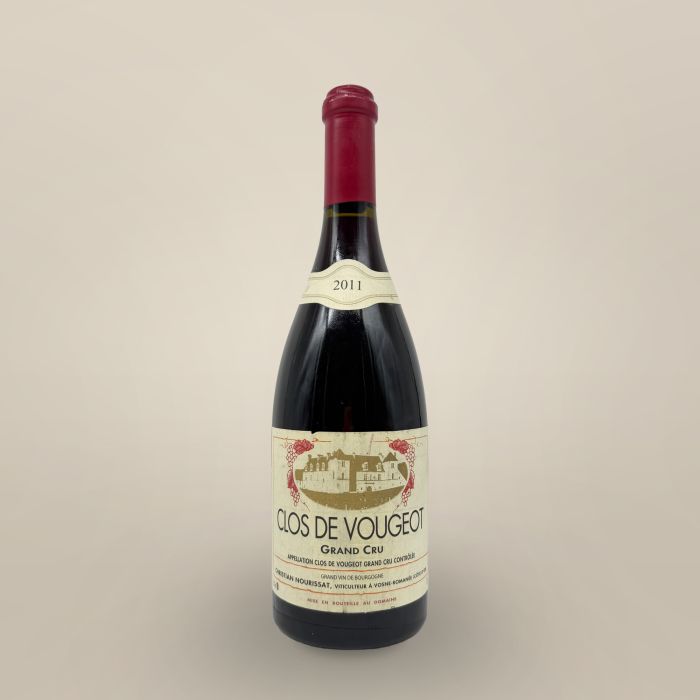
Christian Nourissat Clos Vougeot 2011 Bouteille (75cl)
Christian Nourissat Clos Vougeot 2011 is a Grand Cru red Burgundy wine from Vougeot. It is made exclusively from Pinot Noir. The Clos de Vougeot belongs to the grand crus of the Côte de Nuits and produces exclusively red Pinot Noir wines in the commune of Vougeot. Its vineyard covers 49,43 hectares in production and is divided among numerous owners, which highlights the importance of each individual producer's distinct identity. This 2011 vintage thus expresses a precise interpretation of this grand cru from Burgundy under the signature of Christian Nourissat.
The bottle offered
- Size
- Bottle (75cl)
- Label Condition
- Perfect
- Fill Level
- Perfect
- Capsule Condition
- Perfect
Wine details
- Couleur
- Red
- Pays
- France
- Région
- Bourgogne
- Appellation
- Vougeot
- Producteur / Domaine
- Christian Nourissat
- Parcelle / Cru
- Clos de Vougeot
- Millésime
- 2011
Cépage et assemblage
- Grape Variety
- 100% Pinot Noir
Christian Nourissat
Christian Nourissat refers to an extremely discreet family property in the Clos de Vougeot Grand Cru, rather than an independent wine estate with its own cellars. The plot is farmed under a sharecropping agreement (métayage) by Domaine Leroy, which cultivates the vines, vinifies, and bottles the portion belonging to the family under the Christian Nourissat label. This Pinot Noir red wine is produced in confidential quantities, with no reliable public data regarding the exact surface area or annual number of bottles.
- Owner
- Christian Nourissat / famille Nourissat
Histoire du domaine
The presence of the Nourissat name in Clos de Vougeot is long-standing: a bottle bearing this name from the 1976 vintage notably appears in a French auction catalog. The family property is today associated with Domaine Leroy under a sharecropping (métayage) arrangement, a system whereby the operator works the vines and gives a portion of the production to the owner. According to the professional sources consulted, Leroy farms three plots in Clos de Vougeot and blends the grapes before bottling; the share attributed to the Nourissat family thus corresponds to the same wine as this blend, but it is commercialized under the Christian Nourissat label, in Domaine Leroy bottles. Christian Nourissat vintages are documented at least from the 2000s up to 2021. Sources do not allow for the certain establishment of the start date of the sharecropping, the family's specific surface area, the annual volume produced, or the identity of a cellar master officially attached to this label.
Clos de Vougeot
Clos de Vougeot is a vast, single-piece walled vineyard located at the foot of the Côte de Nuits slope, in the commune of Vougeot. Its terroir varies distinctly from top to bottom: thin, gravelly soils on Bajocian limestone in the upper part, more clayey brown soils on limestone scree in the middle, and deeper, clayey and silty soils on a marly level in the lower part. The site simultaneously constitutes a physically delimited Burgundian climat and the emblematic plot area of the AOC Grand Cru Clos de Vougeot or Clos Vougeot.
- Vineyard commune
- Vougeot
- Origin of the vineyard name
- "Clos" designates the vineyard historically enclosed by walls; "Vougeot" takes up the name of the place, linked to the Vouge which marks a historical boundary of the estate.
- Altitude
- 240–265 m
- Slope
- gentle, averaging approximately 3.8%
- Soil
- At the top, shallow, granular soils rich in gravel; in the middle, shallow, more clayey brown soils on limestone scree; at the bottom, deeper brown soils rich in clay and fine silt.
- Subsoil and geology
- Jurassic complex; Bajocian limestone slab in the upper part, limestone scree in the middle and marly level in the lower part, with the influence of superficial formations linked to the outlet of the Combe d'Orveau.
Le domaine dans cette parcelle
- Vineyard holding status
- Owner; parcel farmed under a sharecropping agreement (métayage) by Domaine Leroy, which handles cultivation and winemaking.
Histoire de la parcelle
The wine estate was gradually established by the Cistercian abbey of Cîteaux from the early 12th century onwards; a medieval agreement set boundaries that have remained almost unchanged, and the wall was built before the end of that century. The farm buildings were developed from the 12th to the 15th century, then supplemented in 1551 by the Renaissance residence that became the Château du Clos de Vougeot. The abbey kept the estate until the French Revolution; the buildings and vineyards were confiscated and then sold as national property in 1791, subsequently leading to the fragmentation of the property. The appellation d'origine contrôlée Clos de Vougeot or Clos Vougeot was recognized by decree on July 31, 1937.