




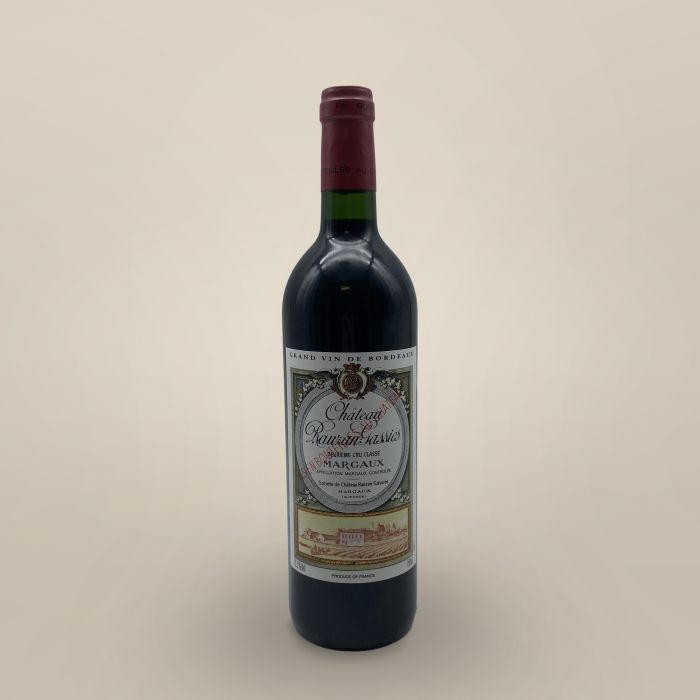
Château Rauzan Gassies 2003
The 2003 Château Rauzan Gassies is a red wine from the Margaux appellation in Bordeaux, produced by Château Rauzan Gassies and classified as a 2nd Growth (Grand Cru Classé) in 1855. Its blend brings together 65% Cabernet Sauvignon, 25% Merlot, and 10% Cabernet Franc. The Wine Advocate awards it 88/100 and Jancis Robinson 16.5/20. Critics describe a medium-bodied and dense wine with dark fruit and plum characters, lifted by spicy and earthy notes, alongside ripe tannins. The indicated drinking windows extend from 2009 to 2017 according to Jancis Robinson and from 2014 to 2024 according to The Wine Advocate.
La bouteille proposée
- Size
- Bottle (75cl)
- Packaging
- Original Wooden Case of 6
- Label Condition
- Perfect
- Fill Level
- Perfect
- Capsule Condition
- Perfect
Identité du vin
- Couleur
- Red
- Pays
- France
- Région
- Bordeaux
- Appellation
- Margaux
- Producteur / Domaine
- Château Rauzan Gassies
- Millésime
- 2003
Cépage et assemblage
- Grape Variety
- 65% Cabernet Sauvignon, 25% Merlot, 10% Cabernet Franc
Château Rauzan Gassies
Château Rauzan-Gassies is a Second Grand Cru Classé from 1855, situated in Margaux, in the Médoc. Its 30-hectare vineyard, planted on deep gravel and gravelly sand, is spread across two hilltops within the appellation. The estate has been owned by the Quié family since 1946 and is managed by Anne-Françoise and Jean-Philippe Quié.
- Owner
- Famille Quié
- Maître de chais
- Jean-Philippe Quié
- Surface (ha)
- 30.00 ha
- Production (average bottles per vintage)
- 100 000 bouteilles/an
Histoire du domaine
The noble house of Gassies, part of the seigneury of Margaux, traces its origins back to the 14th century. The estate’s winemaking history developed in the 17th century under the leadership of Pierre Desmezures de Rauzan, who drew on the experience he had gained at Château Latour to establish the Rauzan estate. In 1763, the estate was divided for inheritance reasons, giving rise to Château Rauzan-Gassies and Rauzan-Ségla. Château Rauzan-Gassies was recognised as a Second Grand Cru in the 1855 Imperial Classification. Paul Quié, a Parisian wine merchant, acquired the estate in 1946. Upon his death in 1968, his son Jean-Michel Quié took over the management and embarked on a programme of renovation, modernisation of the facilities and replanting of the vineyard. Anne-Françoise and Jean-Philippe Quié joined the family estates in 2000; Jean-Philippe is now responsible for technical matters, whilst Anne-Françoise is in charge of sales and marketing. In 2012, the family also added Château Bel Orme Tronquoy-de-Lalande, in the Haut-Médoc, to its portfolio of wine estates.


