




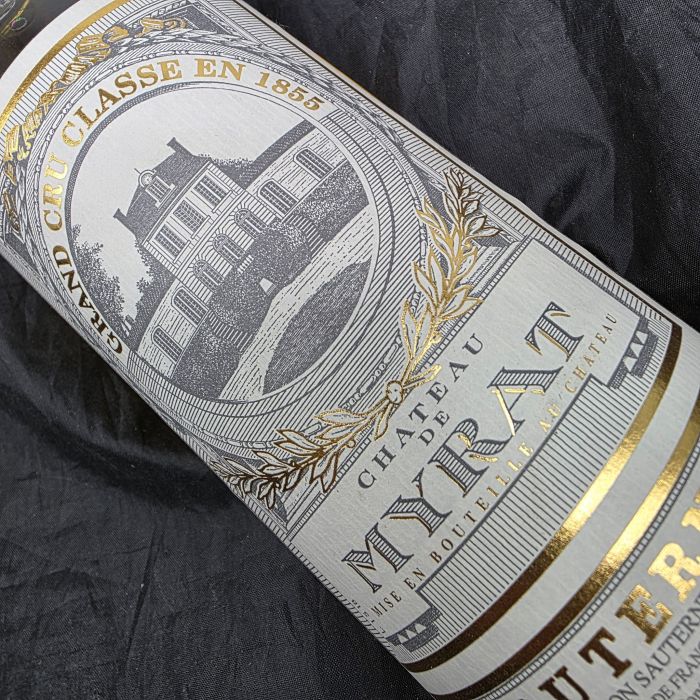
Château Myrat 2018 Bottle (75cl)
Château Myrat 2018 is a sweet white wine from Barsac in Bordeaux, classified as a Second Cru Classé in Sauternes. It is a blend of 88% Sémillon, 8% Sauvignon Blanc, and 4% Muscadelle. The Wine Advocate awarded it 91-93/100, Jancis Robinson 16/20, and James Suckling 89/100. Critics describe a satin-textured palate with sweetness balanced by a taut freshness, leading to a subtly spiced finish. Jancis Robinson recommends enjoying it between 2022 and 2028.
La bouteille proposée
- Size
- Bottle (75cl)
- Label Condition
- Perfect
- Fill Level
- Perfect
- Capsule Condition
- Perfect
Identité du vin
- Couleur
- Sweet
- Pays
- France
- Région
- Bordeaux
- Appellation
- Barsac
- Producteur / Domaine
- Château Myrat
- Millésime
- 2018
Cépage et assemblage
- Grape Variety
- 88% Sémillon, 8% Sauvignon Blanc, 4% Muscadelle
Château Myrat
Château de Myrat is a family-owned estate situated in Barsac, on the limestone plateau of Haut-Barsac, and classified as a Second Growth in the 1855 classification. Its 22-hectare vineyard has belonged to the de Pontac family since 1937. Slanie Ricard de Pontac and Elisabeth de Pontac are currently responsible for managing the estate and producing its wines.
- Owner
- Famille de Pontac
- Maître de chais
- Slanie Ricard de Pontac et Elisabeth de Pontac
- Surface (ha)
- 22.00 ha
- Production (average bottles per vintage)
- environ 30 000 bouteilles/an
Histoire du domaine
Château de Myrat is situated in Barsac, within the Haut-Barsac terroir. The present-day charterhouse was rebuilt around 1730 by the Demirat family on the foundations of older structures. The estate was classified as a second growth in the 1855 Imperial Classification for the wines of Sauternes and Barsac. In 1937, Count Max de Pontac purchased the property, continuing his family’s long-standing connection to the Bordeaux vineyards. Faced with difficulties in marketing sweet wines, the entire vineyard was grubbed up in the mid-1970s. Following the death of Max de Pontac in 1988, his sons Jacques and Xavier decided to replant the vines and renovate the cellars in order to retain their planting rights. The first vintage from the new plantings was produced in 1991, but difficult weather conditions in the early years limited production. Since 2010, Slanie Ricard de Pontac and Elisabeth de Pontac, daughters of Jacques de Pontac, have been involved in vineyard work, cellar operations and marketing, and now manage the estate.


