




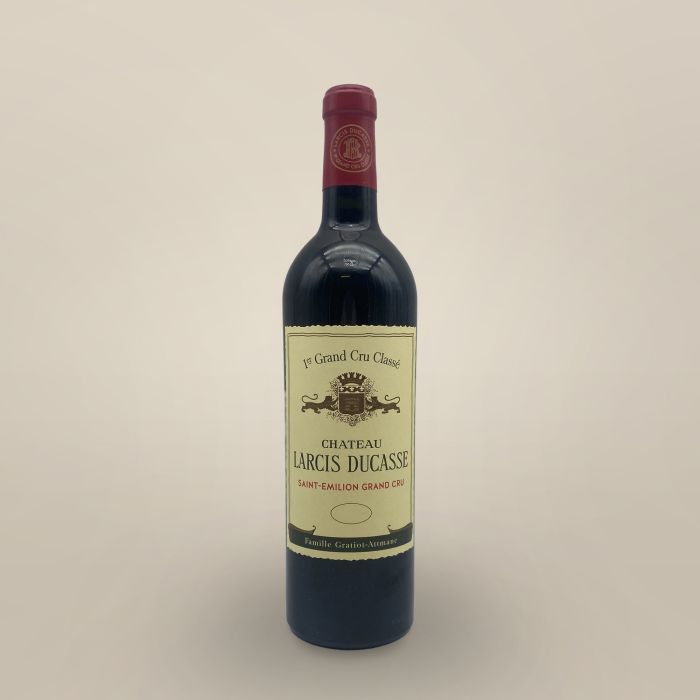
Château Larcis Ducasse 2020 Bottle (75cl)
The 2020 Château Larcis Ducasse is a red wine from Saint-Émilion in Bordeaux, produced by Château Larcis Ducasse and classified as a Grand Cru Classé de Saint-Émilion. Its blend comprises 78% Merlot, 20% Cabernet Franc, and 2% Cabernet Sauvignon. Wine Advocate awards it 96/100, Jancis Robinson 17++/20, and James Suckling 98/100. Critics describe a concentrated and balanced wine, driven by fine tannins, lively freshness, and a persistent finish. Drinking window from 2026 to 2046 according to Wine Advocate, from 2029 to 2040 according to Jancis Robinson; James Suckling recommends waiting until after 2028.
La bouteille proposée
- Size
- Bottle (75cl)
- Packaging
- Original Wooden Case of 6
- Label Condition
- Perfect
- Fill Level
- Perfect
- Capsule Condition
- Perfect
Identité du vin
- Couleur
- Red
- Pays
- France
- Région
- Bordeaux
- Appellation
- Saint Emilion
- Producteur / Domaine
- Château Larcis Ducasse
- Millésime
- 2020
Cépage et assemblage
- Grape Variety
- 78% Merlot, 20% Cabernet Franc, 2% Cabernet Sauvignon
Château Larcis Ducasse
Château Larcis Ducasse is a Saint-Émilion Grand Cru estate situated in Saint-Laurent-des-Combes, on the Grande Côte of the Côte Pavie. Its hillside vineyard, predominantly south-facing, rests on a mosaic of clay-limestone and clay-silt soils. The estate, owned by the Gratiot-Attmane family, has been classified as a Premier Grand Cru Classé since 2012.
- Owner
- Famille Gratiot-Attmane
- Maître de chais
- David Suire
- Surface (ha)
- 11.34 ha
- Production (average bottles per vintage)
- environ 38 000 bouteilles/an
Histoire du domaine
The wines of Larcis Ducasse were already renowned in the 16th century; a high-value sale to the Libourne wine merchant Pierre Beylot is recorded in 1777. In 1841, Lecoutre de Beauvais listed Larcis amongst the finest wines of Saint-Émilion. The owner, Pierre Ducasse, was awarded a gold medal at the Paris World’s Fair in 1867. In 1893, Henry Raba acquired the château and invested in the upkeep of the terraced vineyard as well as in the construction of a gravity-fed wine cellar. Following his death in 1925, his wife Émilie, and then his son André, ensured the continuity of the estate. When André died during the war, his niece Hélène Gratiot-Alphandéry inherited the estate in 1941 and ran it with the estate manager Pharaon Roche. Her son Jacques-Olivier Gratiot succeeded her in 1990. In 2002, the family entrusted the management to Nicolas Thienpont, who was joined by David Suire; work then began on renovating the vineyards and cellars with the support of Julien Lavenu. The château was promoted to Premier Grand Cru Classé in the Saint-Émilion classification in 2012. Since 2024, David Suire has been managing the estate and overseeing the winemaking, whilst the estate continues to pass through the generations within the Gratiot-Attmane family.


