




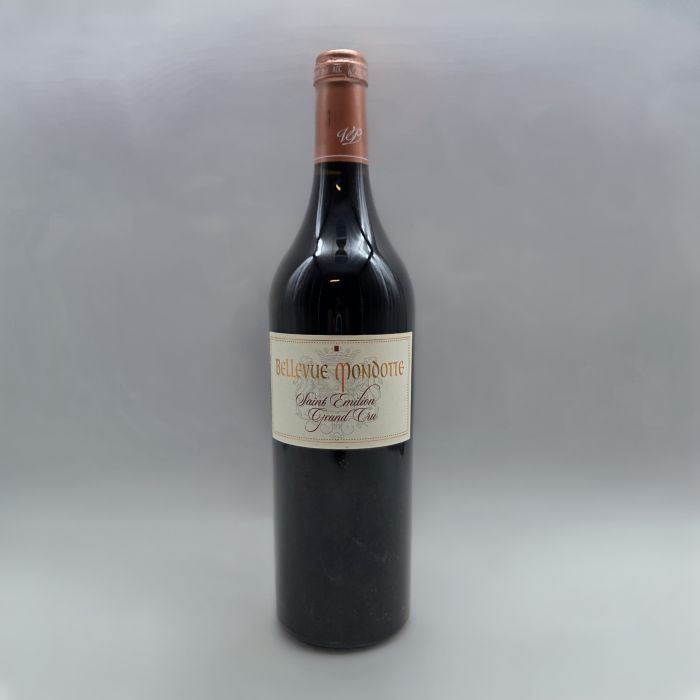
Château Bellevue Mondotte 2020 Bouteille (75cl)
Château Bellevue Mondotte 2020 is a red wine from Saint-Émilion, Bordeaux, produced by Château Bellevue Mondotte and classified as a Grand Cru Classé of Saint-Émilion. Its blend brings together 90% Merlot, 5% Cabernet Franc, and 5% Cabernet Sauvignon. Wine Advocate awards it 96-98/100, Jancis Robinson 16.5/20, and James Suckling 98/100. Critics describe a concentrated and precise wine, driven by a firm tannic structure, black and blue fruits, and a long finish. Wine Advocate advises drinking from 2027 to 2060, while Jancis Robinson indicates 2028 to 2040.
La bouteille proposée
- Size
- Bottle (75cl)
- Packaging
- Original Wooden Case of 12
- Label Condition
- Perfect
- Fill Level
- Perfect
- Capsule Condition
- Perfect
Identité du vin
- Couleur
- Red
- Pays
- France
- Région
- Bordeaux
- Appellation
- Saint Emilion
- Producteur / Domaine
- Château Bellevue Mondotte
- Millésime
- 2020
Cépage et assemblage
- Grape Variety
- 90% Merlot, 5% Cabernet Franc, 5% Cabernet Sauvignon
Château Bellevue Mondotte
Château Bellevue-Mondotte is a 2.5-hectare estate situated south-east of Saint-Émilion, on the clay-limestone plateau overlooking the Dordogne valley. The estate, partly enclosed within the vineyards of Château Pavie-Decesse, produces a Saint-Émilion Grand Cru made predominantly from Merlot. It has been owned by Gérard Perse since 2001.
- Owner
- Gérard Perse
- Maître de chais
- Jean-Baptiste Pion
- Surface (ha)
- 2.00 ha
- Production (average bottles per vintage)
- 4 800 bouteilles/an
Histoire du domaine
Château Bellevue-Mondotte is a very small estate situated on the Pavie plateau in Saint-Émilion. Long little known, it takes its name from its proximity to La Mondotte and Troplong-Mondot. Gérard Perse acquired the property in 2001 and incorporated it into the Vignobles Perse estate, which also includes, notably, the châteaux Pavie, Pavie-Decesse and Monbousquet. The vineyard now covers 2.5 hectares of clay-limestone soils, to the south-east of the village of Saint-Émilion. It is planted predominantly with Merlot, supplemented by Cabernet Franc and Cabernet Sauvignon. The grapes are harvested by hand and vinification takes place in temperature-controlled wooden vats, followed by malolactic fermentation and ageing in barriques. The sources consulted do not allow for a sufficiently certain identification of the person currently directly responsible for the estate’s winemaking.


