




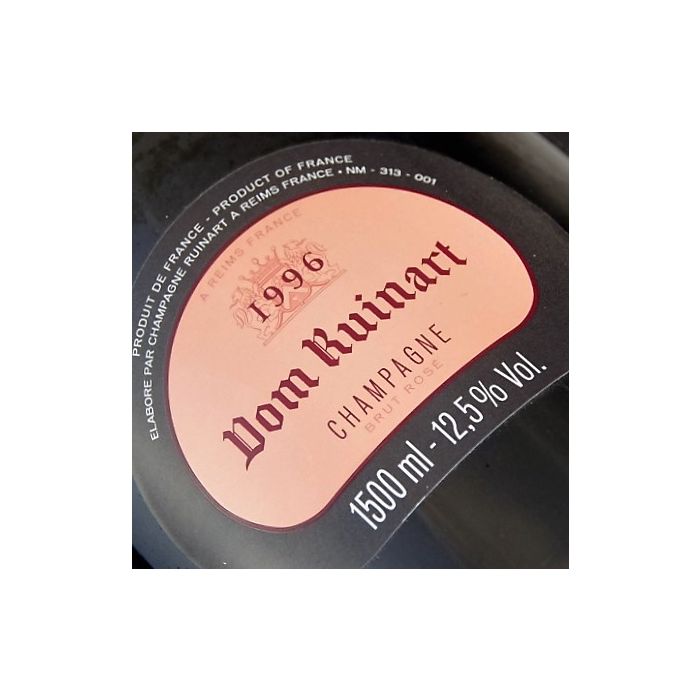
Champagne Dom Ruinart Rose 2002 Bouteille (75cl)
The 2002 Dom Ruinart Rosé from Ruinart is a vintage rosé champagne from Champagne, classified as a Grand Cru. This Dom Ruinart cuvée blends Chardonnay and Pinot Noir. It is rated 96/100 by The Wine Advocate, 17/20 by Jancis Robinson, and 95/100 by James Suckling. Critics describe a rich and structured champagne, marked by toasted notes, citrus fruit, sustained freshness, and a long finish. The Wine Advocate recommends drinking it from 2019 to 2037, while Jancis Robinson indicates a drinking window of 2014 to 2026.
La bouteille proposée
- Size
- Bottle (75cl)
- Packaging
- Gift Box
- Label Condition
- Perfect
- Fill Level
- Perfect
- Capsule Condition
- Perfect
Identité du vin
Cépage et assemblage
- Grape Variety
- Chardonnay, Pinot Noir
Ruinart
Ruinart is a Champagne house based in Reims, founded on 1 September 1729 by Nicolas Ruinart. Part of the LVMH group, it produces its Champagnes from grapes sourced primarily from the Côte des Blancs and the Montagne de Reims. Chardonnay forms the backbone of its blends, whilst its historic chalk cellars are situated beneath the Saint-Nicaise hill in Reims.
- Owner
- LVMH (via sa division Moët Hennessy)
- Maître de chais
- Caroline Fiot
- Production (average bottles per vintage)
- environ 4 à 5 millions de bouteilles/an
Histoire du domaine
In 1728, the royal authorisation to transport Champagne in bottles created a favourable climate for the development of the sparkling wine trade. Nicolas Ruinart, a cloth merchant and nephew of the Benedictine monk Dom Thierry Ruinart, recorded the founding document of the house in his account book on 1 September 1729, in Reims. He initially marketed the sparkling wine to his textile clientele, before Ruinart Père et Fils abandoned the cloth trade in 1736 to devote itself to champagne. Claude Ruinart, the founder’s son, subsequently expanded the house’s markets into Belgium, Germany, the Netherlands and the United Kingdom. In 1764, he shipped sixty bottles of rosé champagne, then known as ‘œil de perdrix’. The family took the name Ruinart de Brimont following their ennoblement in 1817 and continued to expand the house’s business throughout the 19th century. Ruinart acquired the crayères in Reims in 1877 and stored its bottles there; the above-ground buildings, damaged during the First World War, were rebuilt by Charlotte Ruinart following the death of André Ruinart in 1919. After the Second World War, Gérard Ruinart and then Bertrand Mure played a part in reviving the business; the latter launched the Dom Ruinart Blanc de Blancs 1959 in 1966. The house was acquired by LVMH in 1988. Caroline Fiot, who trained within Ruinart’s winemaking team from 2016 onwards, succeeded Frédéric Panaïotis and took up her full duties as cellar master on 1 January 2026.
Dom Ruinart
Dom Ruinart designates the prestige vintage cuvées of the Maison, produced only in years deemed exceptional. The range includes Dom Ruinart Blanc de Blancs, crafted exclusively from Grand Cru chardonnays, and Dom Ruinart Rosé, which combines Grand Cru chardonnays with pinot noir vinified as red wine. These wines benefit from extended aging in Ruinart's chalk cellars (crayères).
- Origin of the cuvée name
- Name given as a tribute to Dom Thierry Ruinart, a Benedictine monk and uncle of Nicolas Ruinart, founder of the Maison.
- Cuvée creation year
- 1959
- Style of the cuvée
- Rare vintage Champagnes centered on the freshness, elegance, and complexity of Grand Cru chardonnay, with a precise structure and long maturation. The Rosé version complements this signature with the fruity and enveloping dimension of pinot noir vinified as red wine.
- Position within the range
- Prestige vintage cuvées, the most accomplished and exclusive expression of Ruinart's expertise.
Histoire de la cuvée
The first Dom Ruinart cuvée was the 1959 Blanc de Blancs, created at the instigation of Bertrand Mure and commercialized in 1966. As the Maison's first 100% chardonnay cuvée, it affirmed chardonnay as Ruinart's signature and was named after Dom Thierry Ruinart. The reference subsequently developed into two prestige expressions: Blanc de Blancs and Rosé.


