




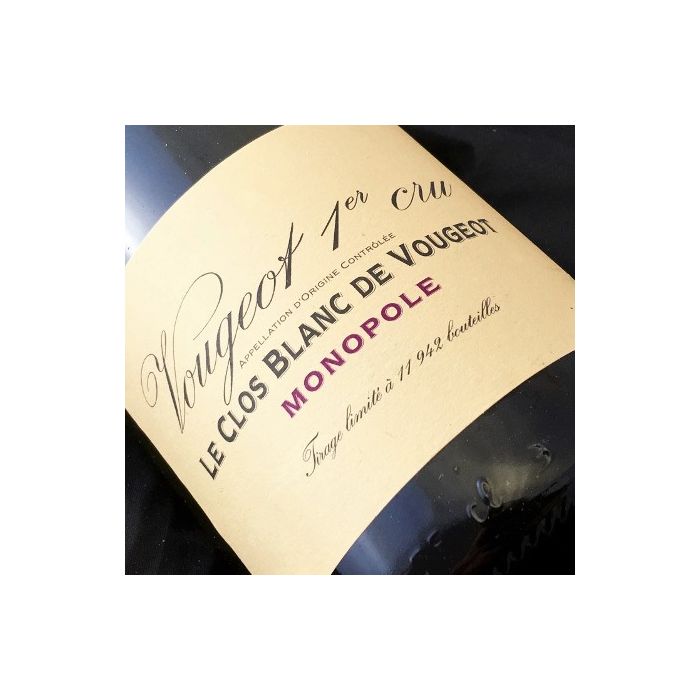
Domain Vougeraie Vougeot Le Clos Blanc 2018
The 2018 Domaine de la Vougeraie Vougeot Le Clos Blanc is a Premier Cru white Burgundy wine from the Le Clos Blanc parcel in the Vougeot appellation. It is 100% Chardonnay. The Wine Advocate awards it 92/100 and recommends drinking it between 2022 and 2040; Jancis Robinson scores it 17/20, with a drinking window from 2021 to 2027. Critics describe a rich and incisive wine, with nuances of pear, peach and citrus, driven by a saline finish and fine length.
La bouteille proposée
- Size
- Bottle (75cl)
- Label Condition
- Perfect
- Fill Level
- Perfect
- Capsule Condition
- Perfect
Identité du vin
- Couleur
- White
- Pays
- France
- Région
- Bourgogne
- Appellation
- Vougeot
- Producteur / Domaine
- Domaine de la Vougeraie
- Parcelle / Cru
- Le Clos Blanc
- Millésime
- 2018
Cépage et assemblage
- Grape Variety
- 100% Chardonnay
Domaine de la Vougeraie
Domaine de la Vougeraie is a family-run Burgundy estate, established in 1999 and based in Premeaux-Prissey. Its vineyards stretch from the Côte de Nuits to the Côte de Beaune and are cultivated using biodynamic methods. It is owned by the Boisset family, represented in particular by Nathalie Berges-Boisset and Jean-Charles Boisset, and holds, amongst other things, the exclusive rights to the Vougeot Premier Cru ‘Le Clos Blanc de Vougeot’.
- Owner
- Famille Boisset (Nathalie Berges-Boisset et Jean-Charles Boisset)
- Maître de chais
- Camille Leynaud-Prince
- Surface (ha)
- 52.15 ha
Histoire du domaine
The Boisset family’s winemaking history, which lies at the origins of Domaine de la Vougeraie, dates back to the 1960s, with the Evocelles vineyards in Gevrey-Chambertin. Over the decades, the family acquired plots in the Côte de Nuits, particularly around Vougeot, and later in the Côte de Beaune. The estate was established under the name Domaine de la Vougeraie in 1999, through the consolidation of these family-owned vineyards and estates acquired gradually. Nathalie Berges-Boisset and her brother Jean-Charles Boisset were involved in its creation. The vineyard has been managed organically since the estate’s inception and has been entirely biodynamic since 2011, according to documentation from the Boisset Group. The estate has developed a plot-by-plot approach, with winemaking and ageing methods tailored to each specific plot. Whole-bunch vinification was introduced for red wines from 2008 onwards, depending on the cuvée and vintage. The winery is located in Premeaux-Prissey, between the Côte de Nuits and the Côte de Beaune. Today, Camille Leynaud-Prince is responsible for the estate’s oenology and winemaking.
Le Clos Blanc
Le Clos Blanc is a Vougeot Premier Cru climat corresponding to the cadastral locality "La Vigne Blanche". It is located mid-slope, in front of the château du Clos de Vougeot and immediately below the north wall of the grand cru. Facing east, it features soil described as highly calcareous, white in color, with a probable clayey-silt component. The site constitutes an undivided monopole of Domaine de la Vougeraie.
- Vineyard commune
- Vougeot
- Origin of the vineyard name
- The climat covers the cadastral locality "La Vigne Blanche", a name associated with its traditional planting of white grapes intended notably for the Cistercians' altar wine.
- Exposure
- East
- Soil
- Very calcareous soil, known as "terre blanche" (white earth); presence of clayey silt indicated as probable.
Le domaine dans cette parcelle
- Estate holding in the vineyard (ha)
- 3.050000 ha
- Vineyard holding status
- sole owner, monopole
- Indicative vine age
- Staggered plantings from 1983 to 2015.
Histoire de la parcelle
The Cistercians of the Cîteaux Abbey farmed the Vougeot terroir from the early 12th century. According to tradition reported by the INAO, La Vigne Blanche has always grown white grape varieties to supply notably the abbey's altar wine; it was also called "Petit Clos Blanc de Cîteaux". The clos remained an undivided property after the sale of national assets following the French Revolution; it notably belonged to Jules Ouvrard, Jules Régnier, and Maison L'Héritier-Guyot before becoming the monopole of Domaine de la Vougeraie.


