




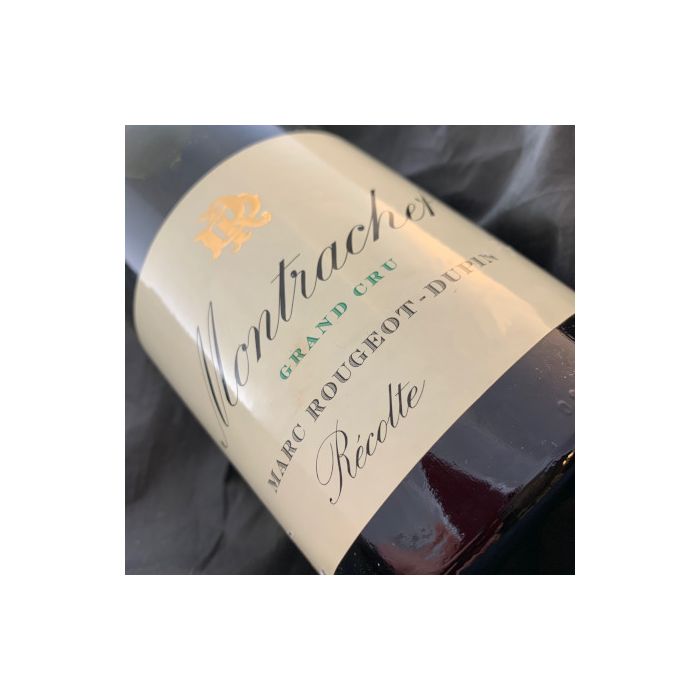
Domain Rougeot Dupin Montrachet 2013 DC
The 2013 Domaine Rougeot Dupin Montrachet is a white Burgundy wine from the Montrachet appellation, classified as a Grand Cru. Crafted from 100% Chardonnay, it originates from the Montrachet parcel. This grand cru is produced in the climat of Montrachet, whose area extends across the communes of Puligny-Montrachet and Chassagne-Montrachet, in the heart of the Côte de Beaune. The Montrachet appellation is exclusively dedicated to Chardonnay white wines.
Identité du vin
- Couleur
- White
- Pays
- France
- Région
- Bourgogne
- Appellation
- Puligny Montrachet
- Producteur / Domaine
- Domaine Rougeot Dupin
- Parcelle / Cru
- Montrachet
Cépage et assemblage
- Grape Variety
- 100% Chardonnay
Domaine Rougeot Dupin
Rougeot-Dupin is a former Burgundy wine merchant based in Meursault, operating under the name SARL Marc Rougeot Dupin. The brand marketed wines from several Burgundian appellations, including regional, communal and grand cru appellations. The company ceased trading in 2025 and no longer exists as an independent entity.
Histoire du domaine
SARL Marc Rougeot Dupin was registered on 1 June 1991 and had its registered office at 6 rue André-Ropiteau in Meursault. Its stated business activity was the wholesale trade in beverages, corresponding to wine trading. The company marketed Burgundy wines from numerous appellations under the name Marc Rougeot-Dupin or Rougeot-Dupin, notably Charmes-Chambertin, Pommard, Richebourg, Romanée-Saint-Vivant and Montrachet. It was linked to Marc Rougeot, who was also a partner in Domaine Rougeot Père et Fils in Meursault, but constituted a trading entity distinct from the family-owned wine estate. The company was wound up early on 30 June 2025, with Marc Rougeot appointed as liquidator. The liquidation proceedings were concluded on that same date; its removal from the Dijon Register of Trade and Companies was subsequently published on 30 September 2025.
Montrachet
Montrachet is a physically delimited climat and Grand Cru appellation shared between Puligny-Montrachet and Chassagne-Montrachet. Its vines occupy a narrow, elongated strip, perpendicular to the slope, in a slight concavity in the lower part of the east- and southeast-facing hillside. The terroir combines red, clayey, calcareous, and very stony soils with Jurassic substrates differentiated by a fault. Its rapid drainage and nocturnal air drainage limit humidity and frost risks.
- Vineyard commune
- Puligny-Montrachet et Chassagne-Montrachet
- Origin of the vineyard name
- The name comes from "Mont Rachet," understood as "bald mountain" or "barren mountain," probably referring to the sparsely vegetated promontory overlooking the site; "râche" is a regional term designating ringworm or scurf.
- Exposure
- East to southeast
- Altitude
- 250–270 m
- Slope
- Lower part of the hillside; strip perpendicular to the slope
- Soil
- Red, clayey, calcareous, very stony, and well-structured soils; locally lean and very stoney soils.
- Subsoil and geology
- Fault separating two sectors; Oxfordian marls rich in iron oxides over Bajocian/Callovian flaggy limestones, with locally highly fragmented Bathonian limestones.
Le domaine dans cette parcelle
- Vineyard holding status
- Negociant under the Marc Rougeot-Dupin brand; sourcing method not specified
Histoire de la parcelle
The cru is attested as early as the 13th century in the form "Mont Rachaz." It truly took off in the 18th century under the impetus of the Clermont-Montoison family, lords of Chagny, and Thomas Jefferson placed it on par with Chambertin in 1787. Puligny and Chassagne appended the name Montrachet to their village names in 1878. A Beaune court ruling defined the appellation of origin in 1921, and the Montrachet AOC was subsequently recognized on July 31, 1937.


