




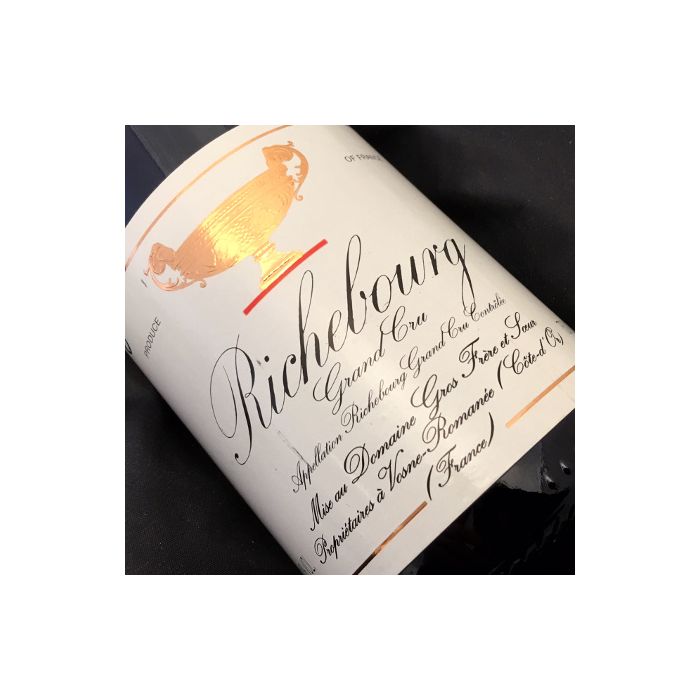
Domain Gros Frere et Sœur Richebourg 1983 -5cm
The 1983 Domaine Gros Frère et Sœur Richebourg is a red Burgundy wine from Vosne-Romanée, produced exclusively from Pinot Noir. It comes from the Richebourg parcel, classified as a Burgundy Grand Cru. This parcel, the jewel of the estate, is located below the Cros Parantoux climat in Vosne-Romanée. A Côte de Nuits grand cru signed by Domaine Gros Frère et Sœur.
La bouteille proposée
- Size
- Bottle (75cl)
- Packaging
- Loose
- Label Condition
- Perfect
- Fill Level
- -5cm
- Capsule Condition
- Perfect
Identité du vin
- Couleur
- Red
- Pays
- France
- Région
- Bourgogne
- Appellation
- Vosne Romanée
- Producteur / Domaine
- Domaine Gros Frère et Soeur
- Parcelle / Cru
- Richebourg
- Millésime
- 1983
Cépage et assemblage
- Grape Variety
- 100% Pinot Noir
Domaine Gros Frère et Soeur
Domaine Gros Frère et Sœur is a family-run estate in Vosne-Romanée, in the Côte de Nuits. Formed in 1963 through the merger of the estates inherited by Gustave and Colette Gros, it cultivates 23 hectares of vineyards, comprising plots in regional, commune-level, Premier Cru and Grand Cru appellations. The seventh generation, Élodie and Vincent Gros, now run the estate.
- Owner
- Famille Gros, via la SAS Gros Frère et Sœur
- Maître de chais
- Vincent Gros
- Surface (ha)
- 23.00 ha
- Production (average bottles per vintage)
- environ 120 000 bouteilles/an
Histoire du domaine
The history of the Gros family in Vosne-Romanée dates back to 1830, when Alphonse Gros, together with his wife Julie, founded the family estate there. His son Louis-Gustave was one of the winegrowers in the Côte de Nuits who pioneered bottling and direct sales to private customers. Over the generations, the family expanded their vineyard. In 1963, following the death of Louis Gros, two of his four children, Gustave and Colette, pooled their shares and established Domaine Gros Frère et Sœur in the family home on Rue des Grands Crus in Vosne-Romanée. As they had no children of their own, they took in their nephew Bernard Gros in 1980 to pass on the trade to him. Following Gustave’s death in 1984, Bernard Gros went into partnership with Colette. Over the course of more than thirty years, he restructured and replanted part of the vineyard. His children, Élodie and Vincent, subsequently joined the business. Bernard Gros handed over the running of the estate to them in 2010, whilst the company remains managed by members of the Gros family. Vincent Gros is recognised as being directly involved in winemaking decisions.
Richebourg
Richebourg is both a Grand Cru appellation and a physically delimited climat of Vosne-Romanée, consisting of the lieux-dits Les Richebourgs and Les Véroilles ou Richebourgs. It occupies the foothills of the slope between 260 and 290 meters, on a gentle slope facing east. Its shallow, clayey, carbonate-rich soils with high iron oxide content rest on Bajocian marls and soft limestones, beneath a colluvial cover blending scree, clays, and silts.
- Vineyard commune
- Vosne-Romanée
- Exposure
- facing east
- Altitude
- 260–290 m
- Slope
- gentle to slight slope
- Soil
- Sparsely developed, carbonate-rich, shallow and heavily clayey soils, rich in iron oxides; colluvium of scree, clays, and silts.
- Subsoil and geology
- Bajocian calcareous marls and soft, frost-susceptible limestones, resting on the Jurassic limestone series of the Côte de Nuits.
Le domaine dans cette parcelle
- Estate holding in the vineyard (ha)
- 0.690000 ha
- Year the vineyard was acquired
- 1882
- Vineyard holding status
- estate owner-grower
- Indicative vine age
- Vineyard replanted in 1989 at a density of 10,000 vines per hectare.
Histoire de la parcelle
The name Richebourg is attested as early as 1512. The Abbey of Cîteaux owned vines on the site, probably since the 17th century, and contributed to its renown. Recognized among the finest crus in the classifications of the 18th and 19th centuries, Richebourg was extended in 1924 to include Les Véroilles sous Richebourg following an agreement between owners ratified by the Court of Appeal of Dijon. The appellation d'origine contrôlée was recognized on September 11, 1936, with the boundaries defined in 1924.


