




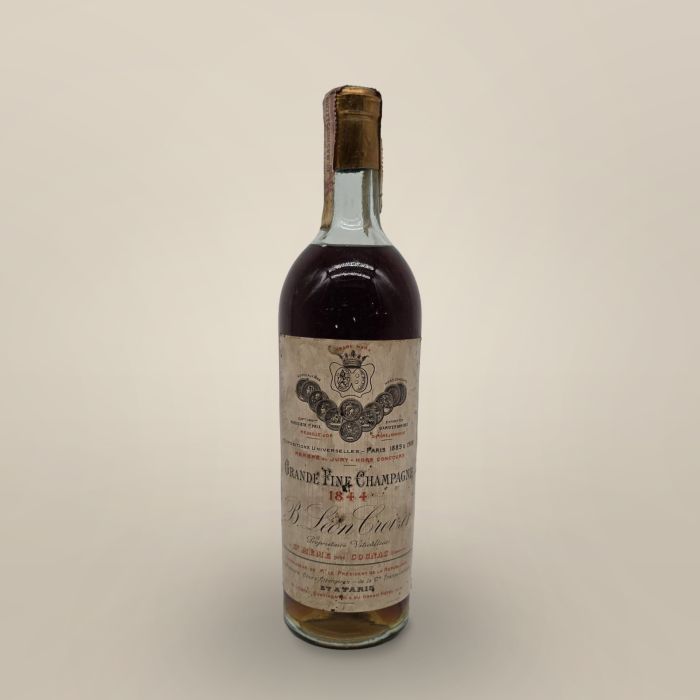
Cognac Léon Croizet Grande Fine Champagne 1844 Bottle (75cl)
La bouteille proposée
- Size
- Bottle (75cl)
- Label Condition
- Perfect
- Fill Level
- Perfect
- Capsule Condition
- Perfect
Identité du vin
- Couleur
- Amber
- Pays
- France
- Région
- Cognac
- Producteur / Domaine
- Léon Croizet
- Millésime
- 1844
Cépage et assemblage
- Grape Variety
- Ugni Blanc
Léon Croizet
Maison Croizet, historically marketed under the name B. Léon Croizet, is established in Saint-Même-les-Carrières, in the heart of Grande Champagne. Its estate covers approximately 150 hectares and notably includes Château de l’Épine and Domaine des Couronnes de Douvesse. The house preserves vintage eaux-de-vie in its former limestone quarries, with archives dating back to 1795.
- Owner
- Léon Croizet
- Surface (ha)
- 150.00 ha
Histoire du domaine
The house was founded in 1805 by Simon Croizet, coming from a family of wine-growing landowners established in Grande Champagne since the 16th century. His descendant Léon Benjamin Croizet (1842-1911), to whom the former commercial designation B. Léon Croizet is linked, played a documented role in the reconstitution of the Charentais vineyard after the arrival of phylloxera: he undertook grafting trials as early as 1871, then developed a public experimental field in 1883. He also expanded the property through the acquisition of the ruins of Château de Saint-Même in 1884 and Logis de Flaville in 1889. Named Knight of the Legion of Honour in 1902 for his wine-growing work, he died in 1911. The house then passed to the Eymard family, to which it had been linked since the marriage in 1892 of Léonie Croizet to Pierre Jean Eymard, notably taking the name Croizet-Eymard. After eight generations of family management, Philippe Eymard sold the house in 2007 to Russian Wine Trust. The Croizet company remains established at 9 rue du Dorland in Saint-Même-les-Carrières and its current management is ensured by Marina Roy, without the consulted public sources allowing to identify with sufficient certainty its current economic beneficiary nor the full name of the cellar master.


